Procedures guides GLP-1 medicines (Ozempic, Wegovy, Rybelsus, Mounjaro, Zepbound)
Taking a GLP-1 before surgery or sedation
Why a slower stomach matters under anesthesia, how the advice changed from 2023 to now, and what your care team may do on the day.
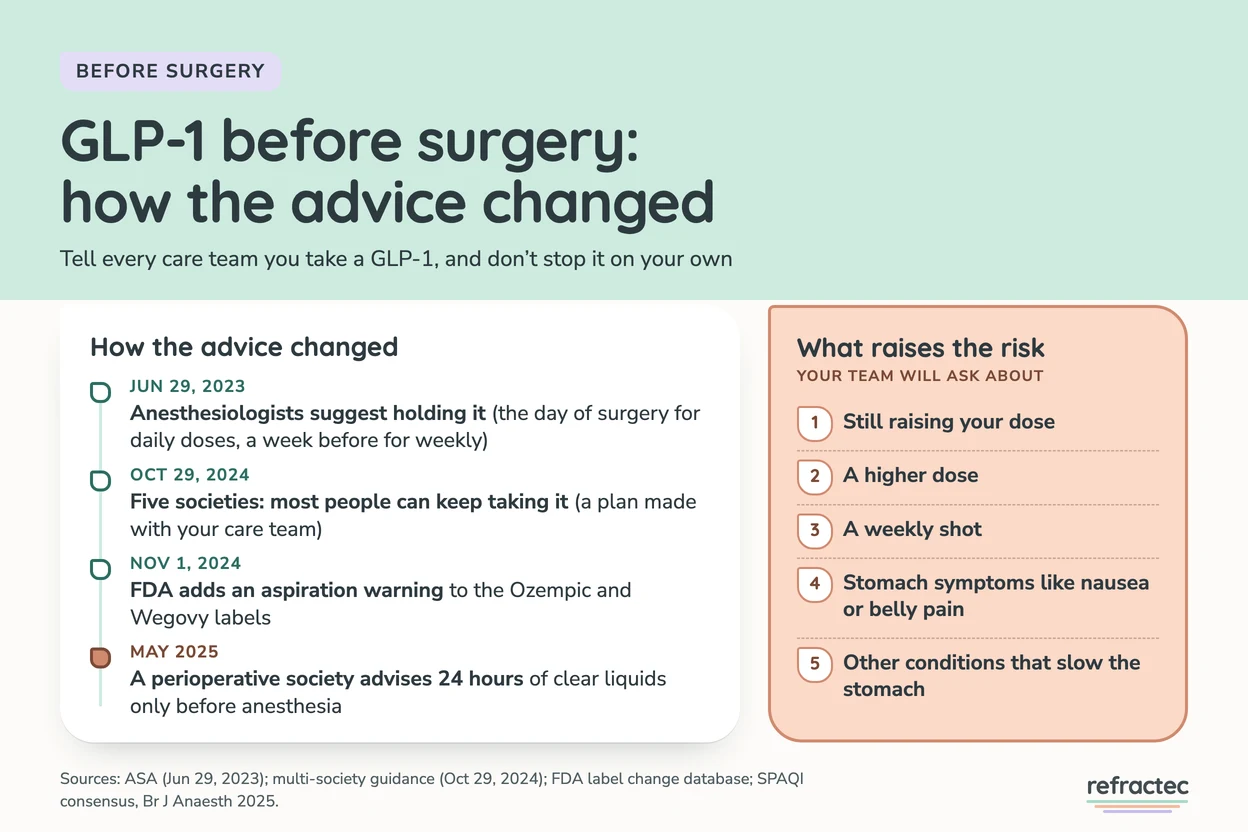
If you take a GLP-1 before surgery, a scope or any procedure with sedation, the most important step is simple: tell every care team. The FDA labels for Wegovy, Ozempic and Zepbound all ask you to do this, and so do other GLP-1 labels.1,2,3 The reason is how these medicines slow your stomach.
The advice on what happens next has changed. In 2023, anesthesiologists suggested pausing the medicine. Since late 2024, five medical societies have said most people can keep taking it. The plan is one you make with your care team.5,6
Do you need to stop your GLP-1 before surgery?
Not always, and not on your own. The current guidance says the choice should come from shared decision-making of the patient with procedural, anesthesia, and prescribing care teams
.6 That means you, the team doing the procedure, the anesthesia team and the person who prescribes your GLP-1.
Some people will keep their usual routine. Others may be asked to change their diet or their dose for a short time. Your prescriber may adjust your plan, so don’t skip or change a dose unless they tell you to.
Why does a GLP-1 matter for anesthesia?
GLP-1 medicines slow how fast food leaves your stomach. The Wegovy and Zepbound labels both say the medicine delays gastric emptying
.1,3 So your stomach may still hold food, even after the usual fasting time.
That matters when you’re asleep or deeply sedated. Your normal reflexes that protect your airway are turned down. If stomach contents come back up, they can get into your lungs. This is called pulmonary aspiration, and it can cause pneumonia.
What does the FDA label say?
Each of these labels now has a warning section about aspiration during general anesthesia or deep sedation.1,2,3 It reports rare postmarketing reports of pulmonary aspiration
in people on GLP-1 medicines. These people had food left in their stomach even though they said they had followed the fasting rules.1
The label is also honest about what isn’t known. It says Available data are insufficient to inform recommendations
on lowering the risk.1 That includes whether longer fasting or a short break from the medicine helps.
The FDA added this warning to the Ozempic and Wegovy labels on Nov 1, 2024.4 The Wegovy Medication Guide puts it plainly: tell all your healthcare providers you take Wegovy before you’re scheduled for surgery or other procedures.1
How has the advice changed since 2023?
June 2023: hold the medicine. The American Society of Anesthesiologists (ASA) published the first guidance on Jun 29, 2023.5 For weekly shots, it said consider holding GLP-1 agonists a week prior to the procedure/surgery
. For daily medicines, it suggested holding them on the day itself.5
October 2024: most people can continue. Five societies released new guidance on Oct 29, 2024. They were the ASA and groups for stomach doctors, weight-loss surgeons, endoscopic surgeons and the care of patients with obesity.6,7 The ASA summed it up this way: Most patients should continue taking their glucagon-like peptide-1 (GLP-1) receptor agonists before elective surgery
.7
The 2024 guidance says GLP-1 therapy may be continued pre-operatively in patients without elevated-risk of delayed gastric emptying and aspiration
.6 If a team decides to hold it, the guidance says the right length of time is unknown
. In that case it points back to the 2023 timing.6
May 2025: a focus on fasting. In 2025, a consensus led by the Society for Perioperative Assessment and Quality Improvement (SPAQI) came out. It was endorsed by the American Association of Clinical Endocrinology, and it also recommends continuing in people without significant stomach symptoms.8 It adds a diet step: We recommend fasting for solids for 24 h (only clear liquids allowed) before procedures requiring anaesthesia
.8
None of this is based on strong trials yet. The 2024 authors call their document guidance, and not an evidence-based guideline
.6 Your hospital may follow one of these documents or its own policy.
Who may be at higher risk?
The 2024 guidance names five things that make a full stomach more likely.6 Your care team will ask about each one.
- You’re still raising your dose. The early dose-raising phase carries more risk than a steady dose.
- You’re on a higher dose. Stomach side effects become more likely as the dose goes up.
- You take a weekly shot. Stomach side effects are more common with weekly forms than daily ones.
- You have stomach symptoms. Nausea, vomiting, belly pain, indigestion and constipation can all be signs your stomach is emptying slowly.
- You have another condition that slows your gut. Examples include gastroparesis, problems with how the bowel moves, and Parkinson’s disease.
If none of these apply to you, the guidance says your GLP-1 may be continued.6 If some do, your team has other tools, described below.
What might your care team do on the day?
Your team may use one or more of these steps. Each comes from the 2023 or 2024 guidance.
- A clear-liquid diet. The 2024 guidance says a liquid diet for
at least 24 h
before the procedure can be used when there’s concern about a slow stomach.6 People getting ready for a colonoscopy do something similar. - A quick stomach ultrasound. The guidance says
point-of-care gastric ultrasound could be used to assess aspiration risk
.6 It’s a scan on your belly that shows whether your stomach is empty. Not every hospital offers it. - A different way to start anesthesia. Your anesthesia team may place a breathing tube quickly, using a method designed for a possibly full stomach.6
- Moving the date. In 2023, the ASA said to consider delaying a planned procedure if you have severe nausea, vomiting, retching, bloating or belly pain on the day.5
For urgent or emergency surgery, the 2023 guidance says to go ahead and treat you as having a full stomach.5 Telling the team about your GLP-1 still helps them plan.
What do the studies show?
The studies point in different directions, and none of them is a randomized trial.
One study looked at 404 people having an upper endoscopy, a scope down the throat, at one hospital in Brazil. Food or fluid was left in the stomach of about 24 in 100 people (24.2%) on semaglutide. That compared with about 5 in 100 (5.1%) of people not on it.9 Only one person in the study breathed in stomach contents, and that person was on semaglutide.9
Bigger studies of actual aspiration found something different. A US claims study looked at more than 6.8 million upper endoscopies in adults with type 2 diabetes. It found aspiration was not more common with GLP-1 medicines.10 Lung problems after the scope were rare, at 6 to 25 for every 10,000 procedures.10
A 2026 study matched 296,389 pairs of adults with type 2 diabetes having surgery in the US. Aspiration happened in 24 people (0.01%) on a GLP-1, compared with 78 (0.03%) who weren’t.11 The authors noted it’s unclear what extra steps care teams took for people on a GLP-1.11
Put together, a GLP-1 can leave food in your stomach, but aspiration itself stays rare. That’s why the advice now focuses on finding the people at higher risk.
What should you do before your procedure?
Start early, at the visit where the procedure is booked. Tell the team your medicine’s name, your dose, how often you take it and when you last raised it. Mention any nausea, vomiting or bloating.
Ask who will make the plan and who will tell the anesthesia team. Then follow the plan you’re given. If you’re asked to change your diet or your dose, make sure you know exactly when to start and when to go back to normal.
Questions to ask your prescriber
Bring these to your next appointment. Tick them off as you go.
Endnotes
- What the Wegovy label says about anesthesia and sedation. Wegovy (semaglutide) injection and tablets, prescribing information and Medication Guide, Novo Nordisk. DailyMed, label revised 6/2026, section 5.10. Retrieved Oct 2026.
- What the Ozempic label tells patients about procedures. Ozempic (semaglutide) injection, prescribing information, Novo Nordisk. DailyMed, label revised 5/2026, sections 5.10 and 17. Retrieved Oct 2026.
- The same warning in the Zepbound label. Zepbound (tirzepatide) injection, prescribing information, Eli Lilly and Company. DailyMed, label revised 8/2026, section 5.9. Retrieved Oct 2026.
- When the FDA added the warning. US Food and Drug Administration. Drug Safety-related Labeling Changes (SrLC) database: Wegovy entry of 11/01/2024 (SUPPL-21) and Ozempic entry of 11/01/2024 (SUPPL-32), aspiration warning newly added. Retrieved Oct 2026.
- The first anesthesia advice, from 2023. American Society of Anesthesiologists. American Society of Anesthesiologists consensus-based guidance on preoperative management of patients (adults and children) on glucagon-like peptide-1 (GLP-1) receptor agonists. News release, Jun 29, 2023, last updated Nov 1, 2024. Retrieved Oct 2026.
- The 2024 guidance from five medical societies. Kindel TL, Wang AY, Wadhwa A, et al. Multi-society clinical practice guidance for the safe use of glucagon-like peptide-1 receptor agonists in the perioperative period. Surg Endosc. 2025;39(1):180-183. doi:10.1007/s00464-024-11263-2.
- The anesthesiologists' summary of the 2024 guidance. American Society of Anesthesiologists. Most patients can continue diabetes, weight loss GLP-1 drugs before surgery. News release, Oct 29, 2024, last updated Feb 18, 2025. Retrieved Oct 2026.
- A 2025 consensus on fasting before anesthesia. Oprea AD, Ostapenko LJ, Sweitzer B, et al. Perioperative management of patients taking glucagon-like peptide 1 receptor agonists: Society for Perioperative Assessment and Quality Improvement (SPAQI) multidisciplinary consensus statement. Br J Anaesth. 2025;135(1):48-78. doi:10.1016/j.bja.2025.04.001.
- Food left in the stomach at endoscopy. Silveira SQ, da Silva LM, de Campos Vieira Abib A, et al. Relationship between perioperative semaglutide use and residual gastric content: a retrospective analysis of patients undergoing elective upper endoscopy. J Clin Anesth. 2023;87:111091. doi:10.1016/j.jclinane.2023.111091.
- Aspiration after upper endoscopy in people with diabetes. Barlowe TS, Anderson C, Sandler RS, et al. Glucagon-like peptide-1 receptor agonists do not increase aspiration during upper endoscopy in patients with diabetes. Clin Gastroenterol Hepatol. 2025;23(5):739-747. doi:10.1016/j.cgh.2024.04.038.
- Breathing problems after surgery in a large US database. Wu HL, Chen JT, Cata JP, et al. Risk of perioperative cardiorespiratory complications and mortality associated with preoperative glucagon-like peptide-1 receptor agonist use in type 2 diabetes mellitus: a nationwide propensity-score matched study. Br J Anaesth. 2026;136(1):86-97. doi:10.1016/j.bja.2025.08.003.
Reviewed against the sources above on Oct 20, 2026. Spotted something out of date? The desk dates every correction on the page.