Serious guides Semaglutide and tirzepatide (Ozempic, Wegovy, Mounjaro, Zepbound)
The Ozempic thyroid cancer warning: what it's based on, and what it means for you
Why semaglutide and tirzepatide carry a boxed warning about thyroid tumors, what large studies in people have found, and the neck symptoms to report.
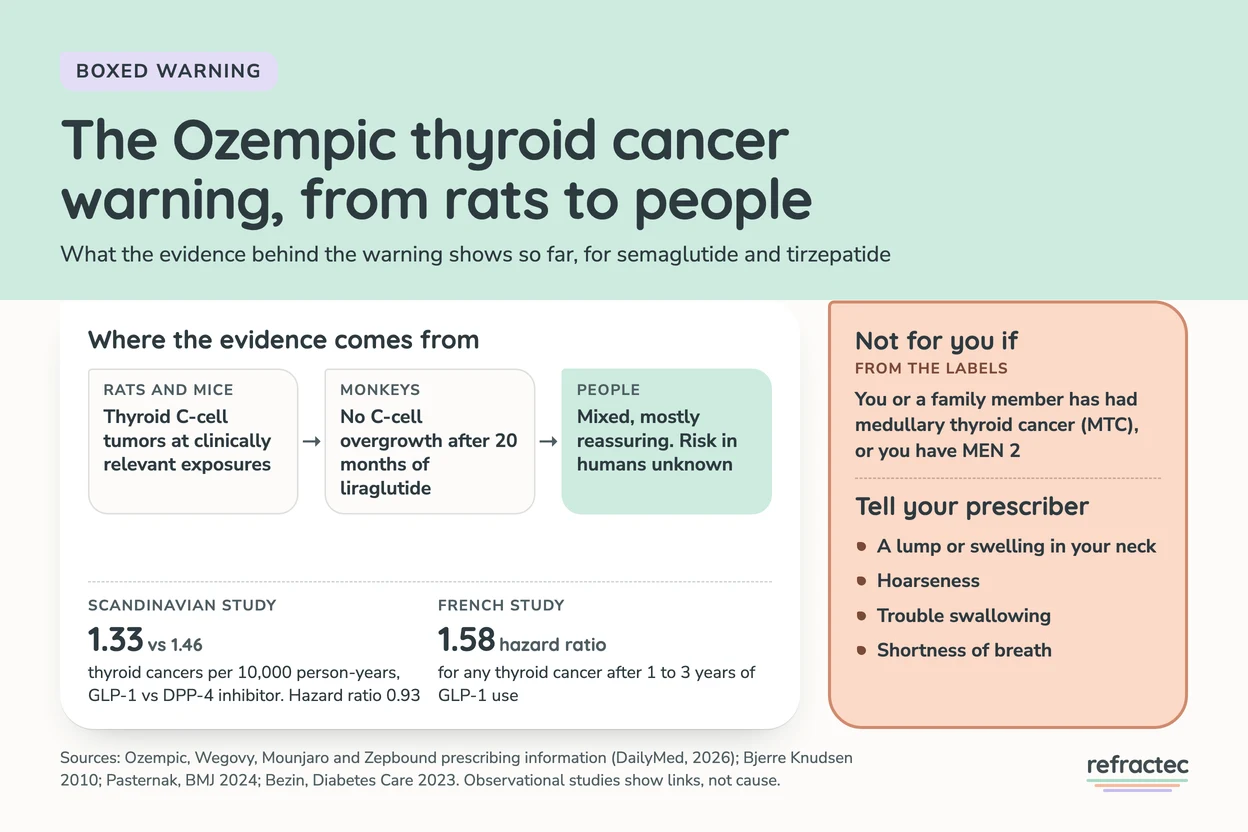
The Ozempic thyroid cancer warning is a boxed warning, printed in a box at the top of the label. It’s there because semaglutide caused thyroid tumors in rats and mice.1 The label says it’s not known whether this happens in people.
The same warning appears on Wegovy, and a similar one on the tirzepatide labels, Mounjaro and Zepbound.2,3 This guide explains what the animal studies found, what studies in people show so far, and which symptoms to report.
What does the warning say?
The Ozempic label starts: In rodents, semaglutide causes thyroid C-cell tumors.
1 C-cells are thyroid cells that release a hormone called calcitonin.4 The cancer that can start in them is called medullary thyroid carcinoma, or MTC.
It’s unknown whether Ozempic causes these tumors in humans. The label explains why: as the human relevance of semaglutide-induced rodent thyroid C-cell tumors has not been determined
.1 The tirzepatide labels say the same about rats.3
The warning also covers who shouldn’t take the medicine. Ozempic is not for anyone with a personal or family history of MTC. It’s also not for people with Multiple Endocrine Neoplasia syndrome type 2 (MEN 2).1 The Wegovy, Mounjaro and Zepbound labels have the same rule.2,3
Why is the warning based on rats?
Both drug makers ran 2-year cancer studies in rodents. In mice and rats, semaglutide caused more thyroid C-cell tumors, and the effect grew with the dose and the length of treatment.1 This happened at clinically relevant exposures
, meaning drug levels similar to those in people.2
Tirzepatide showed the same pattern in a 2-year rat study, at all doses tested.3 In a 6-month study in a special strain of mice, it did not cause tumors.3
Rodents may react more strongly than people do. A 2010 study found GLP-1 receptors on rodent C-cells, while humans and monkeys had low levels of these receptors.4 Monkeys given liraglutide, an older GLP-1 medicine, for 20 months at more than 60 times the human level didn’t develop C-cell overgrowth.4 That study was led by a Novo Nordisk scientist, and its authors noted that the long-term effects in the human thyroid remain unknown
.4
What do studies in people show?
There are no long trials designed to answer this question. What we have are studies that look back at large health records, plus pooled trial data. They don’t all agree.
The most reassuring study. Researchers followed 145,410 people starting a GLP-1 medicine in Denmark, Norway and Sweden from 2007 to 2021.5 They compared them with 291,667 people starting a DPP-4 inhibitor, another diabetes medicine. Thyroid cancer was found in 1.33 per 10,000 people a year on GLP-1s, compared with 1.46 on DPP-4 inhibitors.5 After adjusting for differences between the groups, the hazard ratio was 0.93. A figure of 1 would mean no difference.5
The authors concluded that GLP-1 use was not associated with a substantially increased risk of thyroid cancer
.5 But people were followed for 3.9 years on average, and the result for MTC alone was too uncertain to rule a risk in or out.5
The study that raised the signal. A French study of people with type 2 diabetes compared 2,562 people with thyroid cancer and 45,184 without.6 Using a GLP-1 medicine for 1 to 3 years was linked to about 1.6 times the risk of any thyroid cancer. The hazard ratio was 1.58. For MTC, it was about 1.8 times the risk.6 Like the Scandinavian study, it shows a link, not proof of cause.
Why the studies disagree. The two studies were built differently. The Scandinavian one followed people forward from the day they started a medicine. The French one started with people already diagnosed and looked back at what they had taken.5,6 Both kinds of study can be thrown off by things researchers can’t fully measure.
Pooled trials. A 2024 review of 64 trials lasting at least a year found thyroid cancer was about 1.5 times as likely on a GLP-1 medicine.7 In absolute terms, that’s about one extra case for every 1,349 people treated for 5 years.7 The finding was borderline, and there was no clear link for MTC on its own.7
What does 1.33 in 10,000 mean?
Researchers count this in person-years. Picture 10,000 people taking a GLP-1 medicine for one year. In the Scandinavian study, about 1 or 2 of them would be diagnosed with thyroid cancer in that year.5 Among 10,000 people on the other diabetes medicine, the number was about the same.5
Keep in mind that MTC, the type named in the warning, is only a small share of all thyroid cancers. We explain this below.9
What have regulators concluded?
The US labels still say the human risk is unknown. They also note reports of MTC in people who took liraglutide, but say these reports are insufficient to establish or exclude a causal relationship
.1
In October 2023, the European Medicines Agency’s safety committee reviewed the evidence, including the French study. It concluded that the available evidence does not support a causal association
between GLP-1 medicines and thyroid cancer.8 It made no changes to the product information at that time.8
Does the warning cover every GLP-1 medicine?
All four labels in this guide carry a boxed thyroid warning.1,2,3 The wording differs a little. The semaglutide labels mention rats and mice, while the tirzepatide labels mention rats.1,3
The semaglutide labels also mention the liraglutide reports in people. The tirzepatide labels don’t.1,3 The rule about MTC and MEN 2 is the same on all four.1,2,3
Who should not take these medicines?
The rule is about one type of thyroid cancer. MTC makes up 3% to 4% of all thyroid cancers, and about 25% of cases run in families.9 That’s why a family history matters here.
Don’t take semaglutide or tirzepatide if you or a family member has had MTC, or if you have MEN 2.1,3 The labels don’t address other thyroid conditions or other types of thyroid cancer.1,3 If you’ve had one, ask your prescriber how it applies to you.
Do I need calcitonin tests or neck scans?
Not as a routine. The label says regular calcitonin blood tests or thyroid ultrasounds are of uncertain value
for finding MTC early.1 Testing everyone could lead to procedures people don’t need, because thyroid problems are common and the calcitonin test isn’t very specific.1
If a test is done and calcitonin is high, the label says you should be checked further. The same goes for a nodule found during an exam or on a scan.1
What symptoms should I report?
The Medication Guide lists four signs to tell your prescriber about: a lump or swelling in your neck, hoarseness, trouble swallowing, or shortness of breath
.1 These may be signs of a thyroid tumor. They have many other causes too, so a check is the way to find out.
Questions to ask your prescriber
Bring these to your next appointment. Tick them off as you go.
Endnotes
- What the Ozempic label says about the thyroid. Ozempic (semaglutide) injection, prescribing information and Medication Guide, Novo Nordisk. Label revised May 2026; DailyMed, updated Jun 1, 2026. Retrieved Oct 2026.
- What the Wegovy label says about the thyroid. Wegovy (semaglutide) injection and tablets, prescribing information, Novo Nordisk. Label revised Jun 2026; DailyMed, updated Jun 18, 2026. Retrieved Oct 2026.
- What the Zepbound and Mounjaro labels say about the thyroid. Zepbound (tirzepatide) injection, prescribing information and Medication Guide, label revised Aug 2026; Mounjaro (tirzepatide) injection, prescribing information, label revised Aug 2026. Eli Lilly and Company. DailyMed. Retrieved Oct 2026.
- Why rodents and primates react differently. Bjerre Knudsen L, Madsen LW, Andersen S, et al. Glucagon-like Peptide-1 receptor agonists activate rodent thyroid C-cells causing calcitonin release and C-cell proliferation. Endocrinology. 2010;151(4):1473-1486. doi:10.1210/en.2009-1272. Lead author affiliated with Novo Nordisk.
- The Scandinavian study of thyroid cancer. Pasternak B, Wintzell V, Hviid A, et al. Glucagon-like peptide 1 receptor agonist use and risk of thyroid cancer: Scandinavian cohort study. BMJ. 2024;385:e078225. doi:10.1136/bmj-2023-078225.
- The French study that raised the signal. Bezin J, Gouverneur A, Pénichon M, et al. GLP-1 Receptor Agonists and the Risk of Thyroid Cancer. Diabetes Care. 2023;46(2):384-390. doi:10.2337/dc22-1148.
- A review of 64 trials on thyroid cancer. Silverii GA, Monami M, Gallo M, et al. Glucagon-like peptide-1 receptor agonists and risk of thyroid cancer: A systematic review and meta-analysis of randomized controlled trials. Diabetes Obes Metab. 2024;26(3):891-900. doi:10.1111/dom.15382.
- Europe's review of GLP-1 medicines and thyroid cancer. European Medicines Agency. Meeting highlights from the Pharmacovigilance Risk Assessment Committee (PRAC) 23-26 October 2023. News release, Oct 27, 2023. Retrieved Oct 2026.
- Background on medullary thyroid cancer. National Cancer Institute. Thyroid Cancer Treatment (PDQ), Health Professional Version. Updated May 9, 2025. Retrieved Oct 2026.
Reviewed against the sources above on Oct 19, 2026. Spotted something out of date? The desk dates every correction on the page.