Serious guides Semaglutide (Ozempic, Wegovy, Rybelsus)
Semaglutide and NAION: what we know about the eye risk
A rare optic nerve condition, a signal from observational studies, and regulators who have read it differently. Here's where things stand in October 2026.
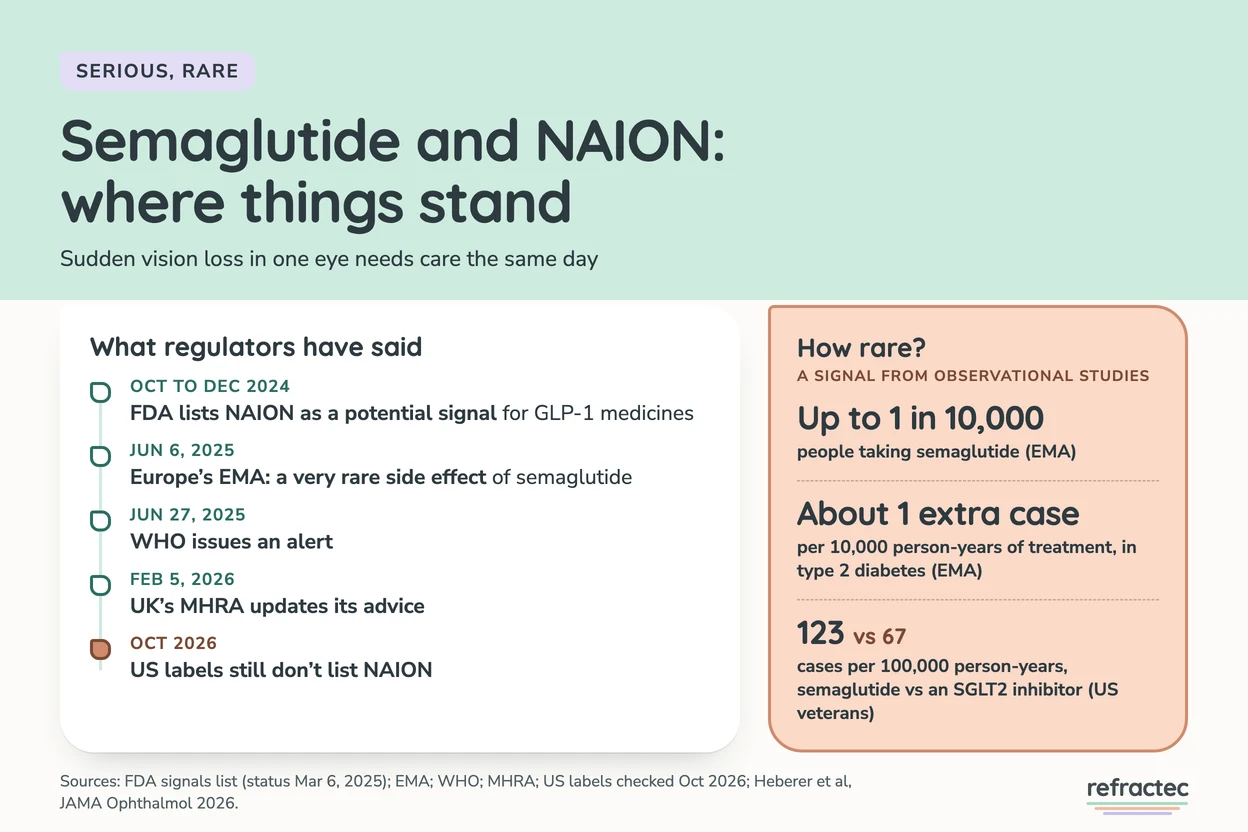
The semaglutide NAION eye risk is a signal from observational studies. Several studies found more cases of NAION, a rare condition that damages the optic nerve, in people taking semaglutide. Europe’s drug regulator now calls it a very rare side effect.1 The US labels for Ozempic, Wegovy and Rybelsus, checked in October 2026, don’t mention it.7,8,9
Studies like these show a link, not proof that the medicine causes NAION. What matters most for you is knowing the warning sign: sudden vision loss in one eye needs care the same day.
What is NAION?
NAION stands for non-arteritic anterior ischemic optic neuropathy. The optic nerve is the cable that carries signals from your eye to your brain. The name describes damage to the front of that nerve from a lack of blood flow. The EMA describes it as an eye condition that may cause loss of vision
.1
It usually shows up as sudden vision loss in one eye. That’s why the UK’s advice to patients talks about sudden loss of vision in one eye
.4 Danish researchers describe it as untreatable, and say it often causes severe vision loss that doesn’t come back.13
Does semaglutide cause NAION?
That hasn’t been proven. All the studies that raised the concern are observational. They look back at health records and compare people who took semaglutide with people who didn’t. They can’t rule out other differences between those groups.
The first study’s authors said so plainly: As this was an observational study, future study is required to assess causality.
12 Even so, regulators in Europe and the UK decided the evidence was strong enough to add NAION to the product information.1,3
The maker, Novo Nordisk, disagrees. A trade journal reported a company spokesperson saying the data did not suggest a reasonable possibility of a causal relationship between semaglutide and NAION
.11
What have regulators said?
Europe, June 2025. The EMA’s safety committee reviewed all available data. On Jun 6, 2025, it said: PRAC has concluded that NAION is a very rare side effect of semaglutide.
1 It said people with sudden vision loss or fast-worsening eyesight should contact their doctor without delay
. It also said semaglutide should be stopped if NAION is confirmed.1
WHO, June 2025. On Jun 27, 2025, the World Health Organization repeated the EMA finding. It said NAION may affect up to 1 in 10,000 users.2 A WHO advisory committee also asked for NAION to be added to semaglutide’s risk management plan as a potential risk.2
United Kingdom, February 2026. The MHRA updated its advice on Feb 5, 2026. It tells prescribers to refer anyone with sudden vision loss, even partial, urgently to an eye specialist. It also says to discontinue semaglutide treatment if NAION is confirmed
.3
The UK had received three reports suggestive of NAION with semaglutide up to Aug 1, 2025.3 Over the past five years, about 10.2 million packs had been dispensed there.4 The MHRA’s chief safety officer, Dr Alison Cave, said the potential risk is extremely small
, but that people should know the symptoms.4
United States, as of October 2026. The FDA put NAION on its list of potential safety signals for GLP-1 medicines in its report for October to December 2024.5 Its note, dated Mar 6, 2025, says: FDA is evaluating the need for regulatory action.
5 The FDA says a listing like this does not mean it has concluded the medicine has the risk.6
We checked again for this article. The current US labels for Ozempic (revised 5/2026), Wegovy (revised 6/2026) and Rybelsus (revised 1/2026) don’t mention NAION or optic neuropathy.7,8,9 The FDA’s record of safety label changes shows no NAION update for Ozempic or Wegovy.10 We found no FDA safety communication on NAION either. As of Oct 18, 2026, the FDA has not issued a public conclusion.
How rare is it?
Very rare, by the measures regulators have used so far.
The EMA’s estimate comes from large studies of adults with type 2 diabetes. They found about twice the risk of NAION on semaglutide compared with people not taking it.1 Because NAION is so uncommon to begin with, that works out to approximately one additional case of NAION per 10,000 person-years of treatment
.1 Person-years add up the time each person was followed, so 10,000 person-years could mean 10,000 people for one year.
A 2026 study of US veterans with type 2 diabetes gives a sense of scale. NAION occurred at a rate of 123 per 100,000 person-years in people who started semaglutide. That compared with 67 per 100,000 in people who started a different diabetes medicine, an SGLT2 inhibitor.16 The authors concluded the risk was about doubled, while the absolute risk was low
.16
What do the studies show, and why do they disagree?
The numbers vary a lot from study to study. Here are the main ones.
- One eye hospital, 2024. This study used records from a neuro-ophthalmology clinic in Boston. People on semaglutide had a hazard ratio of 4.28 if they had type 2 diabetes and 7.64 if they had overweight or obesity.12 These were people already sent to eye specialists, so the numbers don’t apply to the general public.
- All of Denmark, 2024. Among 424,152 people with type 2 diabetes, semaglutide was linked with about twice the risk (hazard ratio 2.19). NAION occurred at 0.228 per 1,000 person-years with semaglutide, compared with 0.093 without it.13
- 14 health databases, 2025. This study covered 37.1 million people with type 2 diabetes. It found
a modest increase in the risk of NAION
,smaller than that previously reported
.14 - Timing, 2025. A large health-records study found no clear rise in the first year on semaglutide. The higher risk showed up from year 2 onward, with a hazard ratio of 2.39 at 2 years.15
- US veterans, 2026. Compared with an SGLT2 inhibitor, semaglutide was linked with a hazard ratio of 2.33.16
- 78 randomized trials, 2025. A review of 73,640 trial participants found more NAION with semaglutide. But the authors said the evidence
remains insufficient to establish definitive conclusions
.17
A hazard ratio of 2 means about twice the rate. Why the spread? The studies looked at different people, compared semaglutide with different medicines, and counted NAION in different ways. NAION is also rare, so a handful of cases can move the numbers a lot.
Is it the same as diabetic retinopathy?
No. The eye warning on the US labels is about a different condition, diabetic retinopathy, which affects the back of the eye in people with diabetes. In a 2-year Ozempic trial, problems from diabetic retinopathy affected 3.0% of people on Ozempic, compared with 1.8% on placebo.7
Both labels ask you to tell your healthcare provider about changes in vision during treatment. The Wegovy label lists this for people with type 2 diabetes.7,8 Whatever the cause, a change in your vision is worth reporting. Just know the two conditions are separate when you read the label.
Does this apply to tirzepatide or other GLP-1s?
It’s not known. The FDA’s signal list named the whole GLP-1 group, including tirzepatide (Mounjaro and Zepbound).5 The EMA’s conclusion was about semaglutide only.1 The MHRA says it is reviewing any evidence for other GLP-1 medicines.3
What should you do?
Keep taking your medicine as prescribed unless your prescriber tells you otherwise. Your prescriber may adjust your plan, so talk with them before you change anything.
Know the warning sign. Sudden loss of vision in one eye, even partial, means going to an emergency room or an eye doctor that day. Tell them you take semaglutide. The MHRA notes that a private prescription may not show up in your medical record, so say it out loud.3
If NAION is confirmed, the EMA and MHRA say semaglutide should be stopped.1,3 Your prescriber will help plan what comes next for your diabetes or weight care.
Questions to ask your prescriber
Bring these to your next appointment. Tick them off as you go.
Endnotes
- Europe's review of semaglutide and NAION. European Medicines Agency. PRAC concludes eye condition NAION is a very rare side effect of semaglutide medicines Ozempic, Rybelsus and Wegovy. News release, Jun 6, 2025, revised Jun 13, 2025. Retrieved Oct 2026.
- The World Health Organization's alert. World Health Organization. Semaglutide medicines and NAION. News item, Jun 27, 2025. Retrieved Oct 2026.
- The UK's advice to prescribers. Medicines and Healthcare products Regulatory Agency (MHRA). Semaglutide (Wegovy, Ozempic and Rybelsus): risk of non-arteritic anterior ischemic optic neuropathy (NAION). Drug Safety Update, Feb 5, 2026. Retrieved Oct 2026.
- The UK regulator's announcement. Medicines and Healthcare products Regulatory Agency (MHRA). MHRA updates guidance for semaglutide prescribers and patients. Press release, Feb 5, 2026. Retrieved Oct 2026.
- The FDA's list of potential safety signals. US Food and Drug Administration. October - December 2024: New safety information or potential signals of serious risks identified by FDA. Row for glucagon-like peptide-1 (GLP-1) receptor agonists, status as of Mar 6, 2025. Retrieved Oct 2026.
- What it means when the FDA lists a signal. US Food and Drug Administration. New safety information or potential signals of serious risks identified by the FDA Adverse Event Monitoring System. Content current as of Sep 30, 2026. Retrieved Oct 2026.
- What the Ozempic label says about your eyes. Ozempic (semaglutide) injection, prescribing information and Medication Guide, Novo Nordisk. DailyMed, label revised 5/2026, sections 5.3, 6.2 and 17. Retrieved Oct 2026.
- What the Wegovy label says about your eyes. Wegovy (semaglutide) injection and tablets, prescribing information and Medication Guide, Novo Nordisk. DailyMed, label revised 6/2026, sections 5.8, 6.2 and 17. Retrieved Oct 2026.
- The Rybelsus label. Rybelsus and Ozempic (semaglutide) tablets, prescribing information, Novo Nordisk. DailyMed, label revised 1/2026. Retrieved Oct 2026.
- The FDA's record of label changes. US Food and Drug Administration. Drug Safety-related Labeling Changes (SrLC) database: Ozempic (latest entry 06/01/2026) and Wegovy (latest entry 03/19/2026). Retrieved Oct 2026.
- The maker's response, as reported in the press (secondary source). Eye disorder is a 'very rare' side effect of weight-loss drugs, concludes EMA review. The Pharmaceutical Journal, Jun 9, 2025. Retrieved Oct 2026.
- The first study, from one eye hospital. Hathaway JT, Shah MP, Hathaway DB, et al. Risk of nonarteritic anterior ischemic optic neuropathy in patients prescribed semaglutide. JAMA Ophthalmol. 2024;142(8):732-739. doi:10.1001/jamaophthalmol.2024.2296.
- A study of everyone with type 2 diabetes in Denmark. Grauslund J, Taha AA, Molander LD, et al. Once-weekly semaglutide doubles the five-year risk of nonarteritic anterior ischemic optic neuropathy in a Danish cohort of 424,152 persons with type 2 diabetes. Int J Retina Vitreous. 2024;10(1):97. doi:10.1186/s40942-024-00620-x.
- A study across 14 health databases. Cai CX, Hribar M, Baxter S, et al. Semaglutide and nonarteritic anterior ischemic optic neuropathy. JAMA Ophthalmol. 2025;143(4):304-314. doi:10.1001/jamaophthalmol.2024.6555.
- A study that looked at timing. Hsu AY, Kuo HT, Wang YH, et al. Semaglutide and nonarteritic anterior ischemic optic neuropathy risk among patients with diabetes. JAMA Ophthalmol. 2025;143(5):400-407. doi:10.1001/jamaophthalmol.2025.0349.
- A study of US veterans. Heberer K, Bress AP, Cogill S, et al. New-onset nonarteritic anterior ischemic optic neuropathy and initiators of semaglutide in US veterans with type 2 diabetes. JAMA Ophthalmol. 2026;144(3):259-264. doi:10.1001/jamaophthalmol.2025.6262. Erratum Jun 2026.
- A review of 78 randomized trials. Natividade GR, Spiazzi BF, Baumgarten MW, et al. Ocular adverse events with semaglutide: a systematic review and meta-analysis. JAMA Ophthalmol. 2025;143(9):759-768. doi:10.1001/jamaophthalmol.2025.2489.
Reviewed against the sources above on Oct 20, 2026. Spotted something out of date? The desk dates every correction on the page.