Interactions guides Tirzepatide (Mounjaro, Zepbound)
Tirzepatide and birth control: what the label says about the pill
Why tirzepatide can weaken birth control pills, the 4-week backup windows on the label, and what to do if you're vomiting or planning a pregnancy.
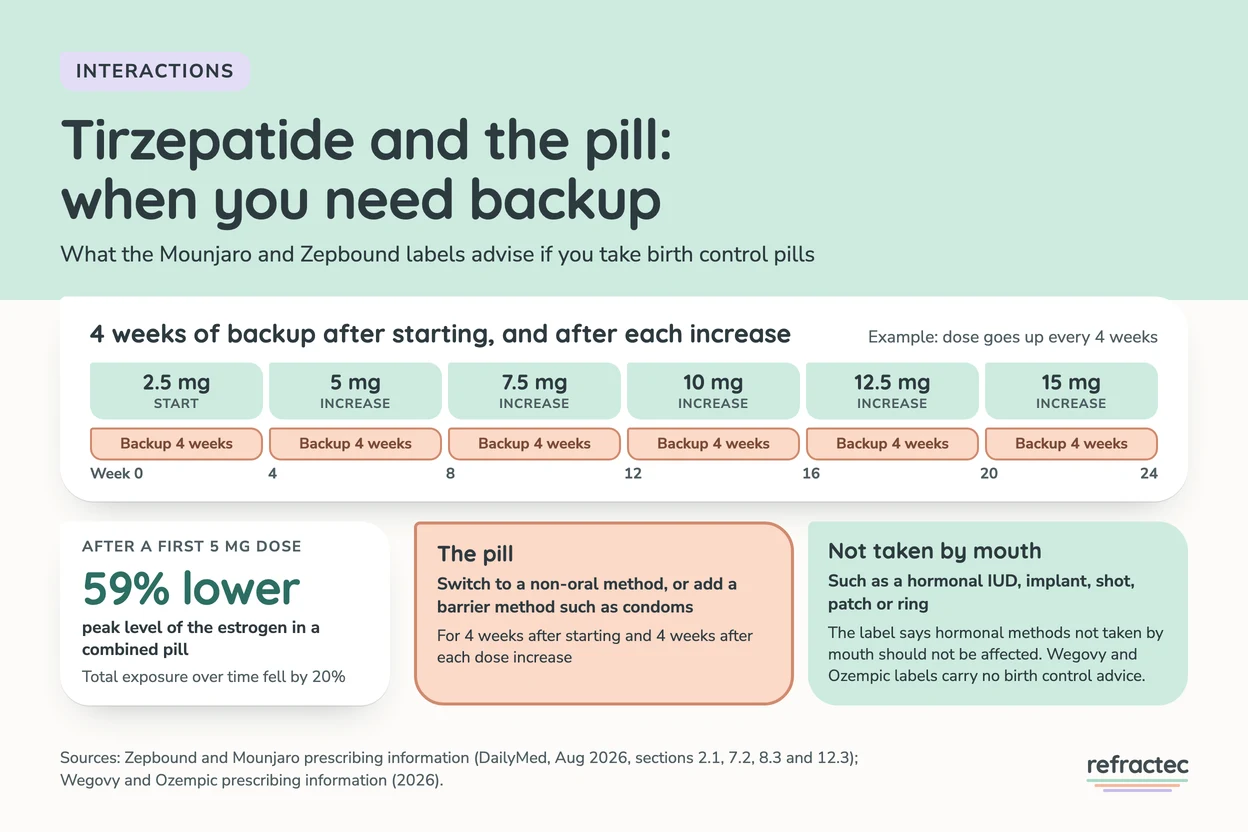
The tirzepatide birth control interaction is about one kind of birth control: the pill. Tirzepatide, sold as Mounjaro and Zepbound, can make pills taken by mouth work less well.1,2 The effect is strongest after your first dose and fades over time.
Both labels give the same advice, whether you take tirzepatide for diabetes or weight. This guide explains what it says, why it happens, how long you need backup, and what’s different with semaglutide (Ozempic, Wegovy).
What does the label say?
The Zepbound label gives prescribers this instruction.1 It says: Advise patients using oral hormonal contraceptives to switch to a non-oral contraceptive method, or add a barrier method of contraception for 4 weeks after initiation with ZEPBOUND and for 4 weeks after each dose escalation.
1 The Mounjaro label says the same.2
In plain words, you have two choices if you take the pill. You can switch to a method you don’t swallow. Or you can keep taking your pill and add a barrier method, like condoms, during certain weeks.
The Zepbound Medication Guide puts it this way: Birth control pills by mouth may not work as well while using ZEPBOUND.
1 It says your prescriber may recommend another type of birth control during those weeks.1
Why does it only affect the pill?
Tirzepatide slows down how fast food leaves your stomach. The label says this delay is largest after the first dose and diminishes over time
.1 A pill you swallow sits in your stomach longer too, which changes how it’s absorbed.
The label describes a study of a combined pill, with an estrogen (ethinyl estradiol) and a progestin (norgestimate).1 After a single 5 mg dose of tirzepatide, the peak level of the estrogen fell by 59%, and the progestin’s by 66%.1 Total exposure over time fell by about 20% to 23%.1
That study looked at drug levels, not at pregnancies. No one knows exactly how much these drops reduce protection. The label’s advice is a careful step to cover that gap.
Birth control that doesn’t go through your stomach avoids the problem. The label says Hormonal contraceptives that are not administered orally should not be affected
.1 By that wording, a hormonal IUD, the implant, the shot, the patch and the ring fall outside the warning. The label doesn’t name these methods or report studies of them.
How long do I need backup protection?
The label sets 4-week windows. You need backup for 4 weeks after your first dose. Then you need it again for 4 weeks after every dose increase.1
Here’s how that fits the label’s dosing plan. Zepbound starts at 2.5 mg once a week for 4 weeks, then moves to 5 mg.1 The dose can then go up in 2.5 mg steps, each after at least 4 weeks on the current dose.1 Your prescriber may adjust this plan to suit you.
So if your dose goes up every 4 weeks, the backup windows join end to end. In that case, you’d use backup the whole time your dose is rising. Going from 2.5 mg all the way to 15 mg that way takes 20 weeks, so the last window ends at week 24.1 Once you’ve been on the same dose for 4 weeks, the label’s backup windows have ended.1
If keeping track feels hard, switching to a non-oral method is the label’s other option.1 UK guidance points out that some methods take time to start working, so ask when yours will protect you.8
What about Ozempic or Wegovy?
The semaglutide labels don’t carry this advice. The Wegovy label lists ethinyl estradiol and levonorgestrel, the hormones in a common pill, among drugs with no meaningful change in levels.3 The Ozempic label shows the same result.4
That comes from a study in 43 women past menopause who had type 2 diabetes.5 The study found semaglutide did not reduce the bioavailability
of the pill’s hormones.5 It measured levels once semaglutide had built up, not right after a first dose.
What if I’m vomiting or have diarrhea?
Stomach side effects are common on tirzepatide, and they can affect any pill.1 The CDC has general advice for this, written for any illness, not just GLP-1 medicines.6
For combined pills, if vomiting or diarrhea lasts less than 48 hours, the CDC says No additional contraceptive protection is needed.
6 If it lasts 48 hours or more, keep taking your pills. Use condoms or avoid sex until you’ve taken pills for 7 days in a row after it ends.6
Progestin-only pills have stricter rules. Say you vomit or have diarrhea within 3 hours of a norethindrone or norgestrel pill. The CDC says to take another pill as soon as possible.7 Then use backup until 2 days after it ends.7 Drospirenone pills have their own rule, so check with your pharmacist.7
Remember that these rules sit on top of the label’s 4-week windows. If you’re inside a window, you already need backup.
What if I had sex without backup?
Don’t wait to find out. Call your pharmacist, prescriber or a sexual health clinic soon, and tell them you take tirzepatide.
Emergency contraception may be an option. For progestin-only pills, the CDC says emergency contraception should be considered
after unprotected sex when pills may not have worked.7 Some types of emergency contraception are pills too, so ask which one suits you.
What do UK regulators say?
The UK advice is close to the US label. People on Mounjaro who take the pill are told to add a barrier method for four weeks after starting and after any dose increase.8 The other choice is to switch to a non-oral method, such as the coil or implant.8
The UK version adds that the pill may work less well in people who are overweight.8 The US label doesn’t make that distinction, so in the US the advice applies to everyone taking the pill.1
What if I’m planning a pregnancy?
Tell your prescriber before you try. The Zepbound label says weight loss offers no benefit to a pregnant patient and may cause fetal harm
.1 It advises stopping Zepbound when a pregnancy is recognized.1
The US tirzepatide labels don’t set a waiting time before trying to conceive. UK guidance suggests stopping tirzepatide at least 1 month before trying.8 For semaglutide, the US labels say to stop at least 2 months before a planned pregnancy.3,4
If you get pregnant while on Zepbound, Lilly runs a pregnancy registry at 1-844-524-0039.1 It tracks how pregnancies go for people exposed to the medicine.
Questions to ask your prescriber
Bring these to your next appointment. Tick them off as you go.
Endnotes
- What the Zepbound label says about birth control. Zepbound (tirzepatide) injection, prescribing information (sections 2.1, 7.2, 8.1, 8.3, 12.2 and 12.3) and Medication Guide, Eli Lilly and Company. Label revised Aug 2026; DailyMed, updated Aug 28, 2026. Retrieved Oct 2026.
- What the Mounjaro label says about birth control. Mounjaro (tirzepatide) injection, prescribing information (sections 7.2 and 8.3), Eli Lilly and Company. Label revised Aug 2026. DailyMed. Retrieved Oct 2026.
- What the Wegovy label says about other medicines and pregnancy. Wegovy (semaglutide) injection and tablets, prescribing information, Novo Nordisk. Label revised Jun 2026; DailyMed, updated Jun 18, 2026. Retrieved Oct 2026.
- What the Ozempic label says about other medicines and pregnancy. Ozempic (semaglutide) injection, prescribing information, Novo Nordisk. Label revised May 2026; DailyMed, updated Jun 1, 2026. Retrieved Oct 2026.
- The semaglutide birth control pill study. Kapitza C, Nosek L, Jensen L, et al. Semaglutide, a once-weekly human GLP-1 analog, does not reduce the bioavailability of the combined oral contraceptive, ethinylestradiol/levonorgestrel. J Clin Pharmacol. 2015;55(5):497-504. doi:10.1002/jcph.443.
- CDC advice on vomiting or diarrhea with combined pills. Centers for Disease Control and Prevention. U.S. Selected Practice Recommendations for Contraceptive Use, 2024: Combined Hormonal Contraceptives. Retrieved Oct 2026.
- CDC advice on vomiting or diarrhea with progestin-only pills. Centers for Disease Control and Prevention. U.S. Selected Practice Recommendations for Contraceptive Use, 2024: Progestin-Only Pills. Retrieved Oct 2026.
- The UK's advice on GLP-1 medicines, contraception and pregnancy. Medicines and Healthcare products Regulatory Agency (MHRA). GLP-1 medicines for weight loss and diabetes: what you need to know. Updated Feb 5, 2026. Retrieved Oct 2026.
Reviewed against the sources above on Oct 20, 2026. Spotted something out of date? The desk dates every correction on the page.