Serious guides GLP-1 medicines (semaglutide, tirzepatide, liraglutide)
GLP-1 gallbladder problems: how common are gallstones?
What the FDA labels report about gallstones and gallbladder inflammation, how weight loss plays a part, and the signs that mean you should call.
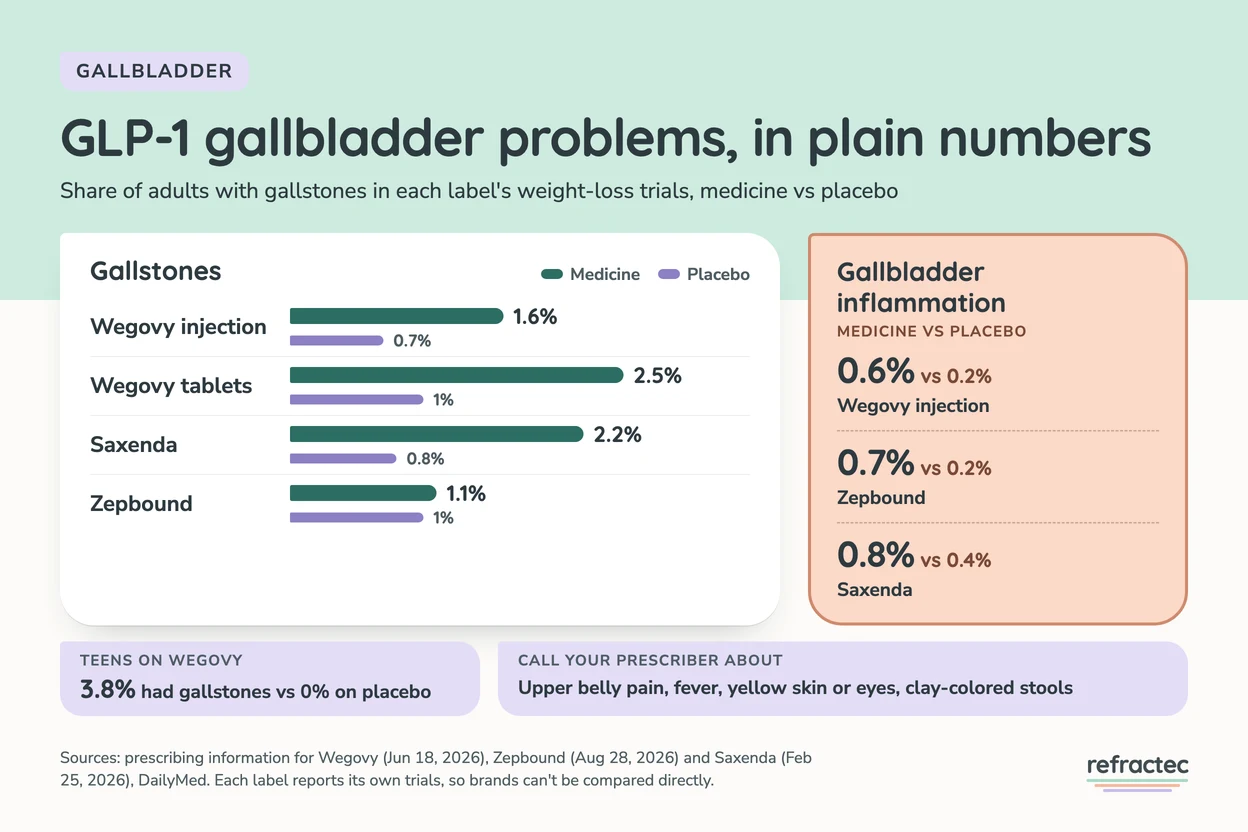
GLP-1 gallbladder problems are uncommon, but every label for these medicines warns about them. In weight-loss trials, gallstones affected about 2 in 100 adults (1.6%) on Wegovy injection, compared with under 1 in 100 (0.7%) on placebo.1 Most people never have a problem, so it helps to know the signs.
This guide uses the FDA labels for Wegovy and Ozempic (semaglutide), Zepbound and Mounjaro (tirzepatide), and Saxenda (liraglutide). Each rate sits beside its placebo rate, so you can see how much the medicine adds.
What does the gallbladder do?
Your gallbladder is a small pouch under your liver. It stores bile, a fluid that helps you digest fat. Gallstones can form when bile holds too much cholesterol or when the gallbladder doesn’t empty fully or often enough.2
Most people with gallstones have no symptoms at all. Trouble starts when a stone blocks a bile duct. That can cause a painful attack, or inflammation of the gallbladder, called cholecystitis.2
Can GLP-1 medicines cause gallbladder problems?
Yes, the labels say they can raise the risk. The Wegovy label puts it plainly: Treatment with WEGOVY is associated with an increased occurrence of cholelithiasis and cholecystitis.
1 Cholelithiasis is the medical word for gallstones.
The Zepbound label says the same of tirzepatide and of GLP-1 medicines as a group.3 The Ozempic and Mounjaro labels note that gallbladder events have been reported in trials of GLP-1 medicines and after they went on sale.4,5
How common are gallstones on each medicine?
Each label reports its own trials, with different people, doses and lengths. That means the rates can’t be lined up as a contest between brands. Here is what each label says.
| Medicine (trials in the label) | Gallstones on the medicine | Gallstones on placebo |
|---|---|---|
| Wegovy injection, adults losing weight | 1.6% | 0.7% |
| Wegovy tablets, adults losing weight | 2.5% | 1% |
| Saxenda, adults | 2.2% | 0.8% |
| Zepbound, two weight-loss trials | 1.1% | 1% |
| Ozempic 0.5 mg, type 2 diabetes | 1.5% | 0% |
| Ozempic 1 mg, type 2 diabetes | 0.4% | 0% |
Sources: Wegovy, Saxenda, Zepbound and Ozempic labels.1,3,4,6
Semaglutide tablets for diabetes (Rybelsus and Ozempic tablets) show a similar picture. In a 4-year heart outcomes trial, gallstones affected 1.1% on the 14 mg tablet, compared with 0.9% on placebo.7 Gallbladder inflammation affected 1.1% compared with 0.7%.7
For Mounjaro, the label groups gallstones, gallbladder pain and gallbladder removal together. These affected 0.6% of adults on Mounjaro in placebo-controlled trials, compared with 0% on placebo.5
How often does the gallbladder get inflamed?
Inflammation of the gallbladder is rarer than gallstones. On Wegovy injection, it affected 0.6% of adults, compared with 0.2% on placebo.1 On Zepbound, it was 0.7% compared with 0.2%.3 On Saxenda, it was 0.8% compared with 0.4%.6
Some people need their gallbladder taken out. In the Zepbound weight-loss trials, 0.2% had gallbladder surgery, compared with no one on placebo.3 The Saxenda label says most people who had gallstones or inflammation on Saxenda needed their gallbladder removed.6 The Ozempic label also lists gallbladder removal among reports made after the drug went on sale.4
The Wegovy Medication Guide says plainly: Some gallbladder problems need surgery.
1 Gallbladder removal is one of the most common operations in US adults, and the NIDDK says you can live normally without a gallbladder.8 Your care team will explain the options if it comes to that.
Is it the medicine or the weight loss?
Probably some of both. Losing weight quickly is a known cause of gallstones, and the labels say so.1,6 But the Wegovy and Saxenda labels add a key point. Gallbladder problems were still more common on the medicine than on placebo, even after accounting for the degree of weight loss.
1,6
The Saxenda label tells prescribers to explain that gallbladder disease may also occur in the absence of substantial or rapid weight loss.
6 The Zepbound label puts it differently. It says gallbladder events were associated with weight reduction.
3 The labels don’t settle exactly how much each cause adds.
What does a large research review show?
A 2022 review pooled 76 randomized trials with 103,371 people.9 People taking a GLP-1 medicine were about 37% more likely to have a gallbladder or bile duct problem than people on a comparison treatment.9
The rise was bigger in some groups. In trials for weight loss, the risk was a little more than double. It was also higher at higher doses and with longer use.9 Remember that these are relative numbers. A doubling of a small risk is still a small risk for most people.
Who might be at higher risk?
- Teens on Wegovy. In a trial of people aged 12 and older, gallstones affected 3.8% on Wegovy, compared with 0% on placebo. The label says the rates were higher than in adults.1
- People on higher doses or longer treatment. The research review linked both with more gallbladder problems.9
- People losing weight fast. Rapid weight loss raises gallstone risk on its own, and obesity is a risk factor too.1,2
If you’ve had gallstones before, tell your prescriber. They can help you decide what to watch for.
What does a gallbladder attack feel like?
A gallbladder attack usually causes pain in your upper right belly. It can last several hours. Attacks often follow a heavy meal and tend to happen in the evening or at night.2
The Wegovy and Zepbound Medication Guides list the signs to report. They are pain in your upper stomach (abdomen)
, fever, yellow skin or eyes, and clay-colored stools
.1,3 The NIDDK says to see a doctor right away if pain lasts several hours, or comes with fever, chills, vomiting or yellow skin.2
Gallbladder pain can feel like other problems, including pancreatitis.2 Gallstones are one of the most common causes of pancreatitis, which is another warning on these labels.10 That’s one more reason to get belly pain checked rather than wait it out.
What happens if your doctor suspects gallstones?
The labels say that if gallstones are suspected, your doctor should arrange gallbladder tests and follow-up care.1,4 Ask what the tests will look for and when you’ll hear the results.
The labels don’t say whether gallstones go away if you stop the medicine. Your prescriber may adjust your treatment, so talk with them before you change or stop a dose.
Questions to ask your prescriber
Bring these to your next appointment. Tick them off as you go.
Endnotes
- What the Wegovy label says about gallbladder disease. Wegovy (semaglutide) injection and tablets, prescribing information and Medication Guide, Novo Nordisk. DailyMed, label version effective Jun 18, 2026 (section 5.3). Retrieved Oct 19, 2026.
- What a gallbladder attack feels like. National Institute of Diabetes and Digestive and Kidney Diseases (NIDDK). Symptoms and Causes of Gallstones. Last reviewed November 2017. Retrieved Oct 19, 2026.
- What the Zepbound label says about gallbladder disease. Zepbound (tirzepatide) injection, prescribing information and Medication Guide, Eli Lilly and Company. DailyMed, label version effective Aug 28, 2026 (section 5.4). Retrieved Oct 19, 2026.
- What the Ozempic label says about gallbladder disease. Ozempic (semaglutide) injection, prescribing information, Novo Nordisk. DailyMed, label version effective Jun 1, 2026 (sections 5.9 and 6.2). Retrieved Oct 19, 2026.
- What the Mounjaro label says about gallbladder disease. Mounjaro (tirzepatide) injection, prescribing information, Eli Lilly and Company. DailyMed, label version effective Aug 27, 2026 (section 5.8). Retrieved Oct 19, 2026.
- What the Saxenda label says about gallbladder disease. Saxenda (liraglutide) injection, prescribing information, Novo Nordisk. DailyMed, label version effective Feb 25, 2026 (sections 5.3 and 17). Retrieved Oct 19, 2026.
- What the Rybelsus label says about gallbladder disease. Rybelsus and Ozempic (semaglutide) tablets, prescribing information, Novo Nordisk. DailyMed, label version effective Jan 30, 2026 (section 5.8). Retrieved Oct 19, 2026.
- How gallstones are treated. National Institute of Diabetes and Digestive and Kidney Diseases (NIDDK). Treatment for Gallstones. Last reviewed November 2017. Retrieved Oct 19, 2026.
- A review of 76 trials on GLP-1 medicines and the gallbladder. He L, Wang J, Ping F, et al. Association of Glucagon-Like Peptide-1 Receptor Agonist Use With Risk of Gallbladder and Biliary Diseases: A Systematic Review and Meta-analysis of Randomized Clinical Trials. JAMA Intern Med. 2022;182(5):513-519. doi:10.1001/jamainternmed.2022.0338. PubMed abstract retrieved Oct 19, 2026.
- How gallstones are linked to pancreatitis. National Institute of Diabetes and Digestive and Kidney Diseases (NIDDK). Symptoms and Causes of Pancreatitis. Retrieved Oct 19, 2026.
Reviewed against the sources above on Oct 20, 2026. Spotted something out of date? The desk dates every correction on the page.