Serious guides GLP-1 medicines (semaglutide, tirzepatide)
GLP-1 pancreatitis risk: what the trials found, and the signs to know
How often pancreatitis showed up in the trials, why your lipase result may rise, and the belly pain that means you should stop and call.
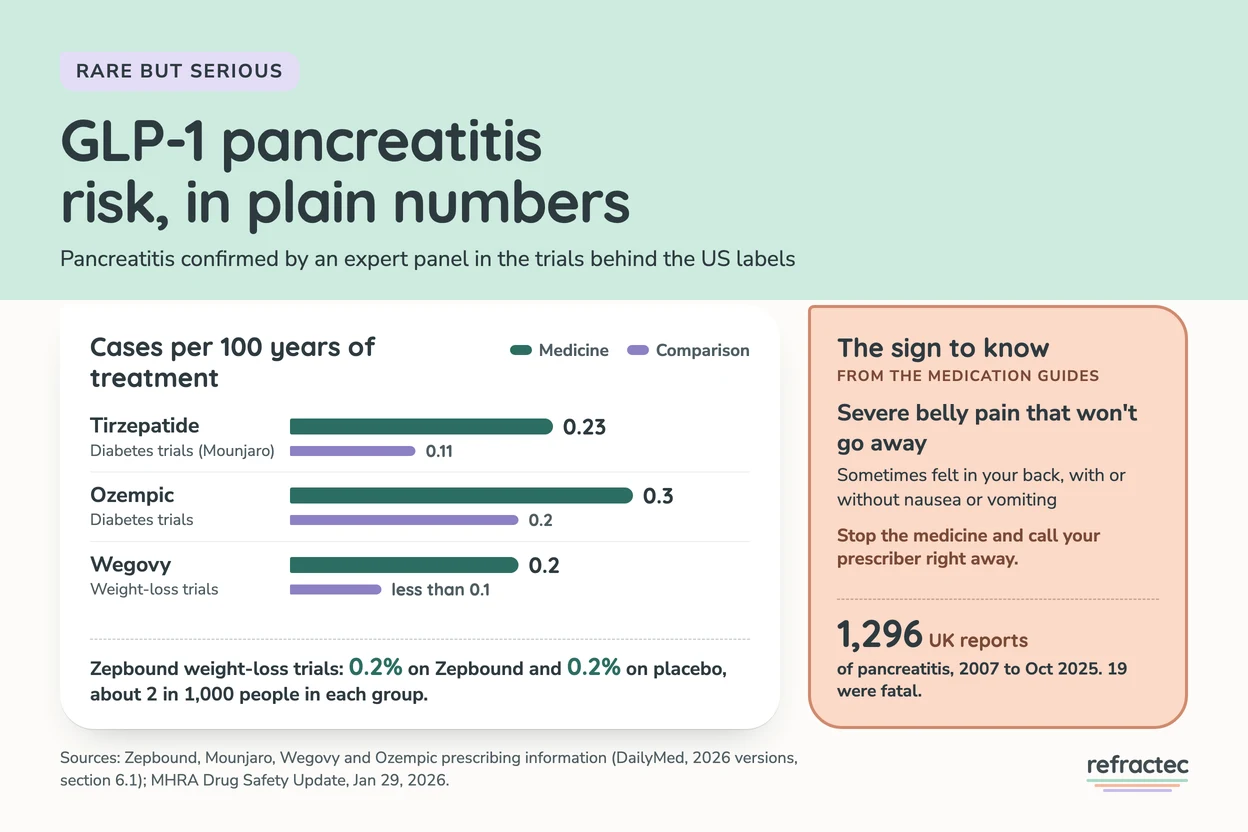
Pancreatitis means your pancreas has become inflamed. The GLP-1 pancreatitis risk is low in the trials behind the labels, but every label for semaglutide and tirzepatide carries a warning about it.1,3 That’s because a small number of cases can be severe.
This guide uses the US labels for Zepbound, Mounjaro, Wegovy and Ozempic, plus a 2026 update from the UK drug regulator. It covers how often pancreatitis happened, what the warning signs are, and what to do if you notice them.
What does the label warning say?
The warning is almost word for word the same on all four labels. The Wegovy label says Acute pancreatitis, including fatal and non-fatal hemorrhagic or necrotizing pancreatitis, has been observed in patients treated with GLP-1 receptor agonists
.3 Hemorrhagic and necrotizing pancreatitis are severe forms of the illness.
The labels tell prescribers to watch for persistent or severe abdominal pain (sometimes radiating to the back)
, which may come with nausea or vomiting.3 If pancreatitis is suspected, the labels say the medicine should be stopped.1,3
How common is pancreatitis in the trials?
It’s rare. In the trials, a panel of experts reviewed each possible case and confirmed it or ruled it out. In two Zepbound weight-loss trials, 0.2% of people on Zepbound had confirmed pancreatitis, compared with 0.2% on placebo.1 That’s about 2 in every 1,000 people in both groups.
Other trials report cases per 100 years of treatment. Think of it as 100 people each taking the medicine for one year. Here is what the labels show:
- Tirzepatide for diabetes. 13 people had confirmed pancreatitis, a rate of 0.23 per 100 years. That compares with 0.11 on the comparison treatments.2
- Ozempic. 7 people had confirmed pancreatitis, a rate of 0.3 per 100 years, compared with 0.2 on the comparison treatments.4
- Wegovy for weight loss. 4 people had confirmed pancreatitis, a rate of 0.2 per 100 years. On placebo, 1 person did, a rate below 0.1.3
- Zepbound for sleep apnea. In two smaller trials with 467 adults, the rate was 0.84 per 100 years on Zepbound and 0 on placebo.1 With so few people, one or two cases can move these numbers a lot.
Do bigger studies show a higher risk?
A 2025 review pooled 62 trials with 66,232 people taking several GLP-1 medicines.7 Pancreatitis was 1.44 times as likely on a GLP-1 as on the comparison treatment. The authors called this a slightly increased risk of pancreatitis
.7
That figure is relative. When the starting risk is a few cases in 1,000, a 44% rise still leaves the absolute risk small. The link also lost statistical significance when the authors grouped trials by the other diabetes medicines people were taking.7
What are the warning signs?
The main sign is belly pain that is severe, or that won’t go away. The Medication Guides for Wegovy and Zepbound tell you what to do.1,3 The Wegovy guide says: Stop using WEGOVY and call your healthcare provider right away if you have severe pain in your stomach area (abdomen) that will not go away, with or without nausea or vomiting.
3 They add that you may feel the pain from your belly through to your back.1,3
This can be hard to spot early. The UK regulator notes that the first symptoms are belly pain, nausea or vomiting. These can look like the usual stomach side effects of these medicines, or like an infection.5 If your pain feels different, stronger or longer-lasting than usual, treat it as new.
Gallbladder problems are a separate warning on these labels, and their signs overlap. They include pain in your upper belly, fever, yellow skin or eyes, and clay-colored stools.3 Both need a call to your prescriber.
Why did my lipase or amylase go up?
Lipase and amylase are pancreas enzymes that can be measured with a blood test. On these medicines, they tend to rise a little even in people who feel fine.
- Zepbound: amylase rose 20% to 25% and lipase 28% to 35% on average, compared with 2.1% and 5.8% on placebo.1
- Mounjaro: amylase rose 33% to 38% and lipase 31% to 42%. On placebo, amylase rose 4% and lipase did not change.2
- Wegovy: amylase rose 15% to 16% and lipase 39%. These changes were not seen on placebo.3
- Ozempic: amylase rose 13% and lipase 22%, again not seen on placebo.4
Each label says the meaning of these rises is unknown in the absence of other signs and symptoms of pancreatitis
.1 A high number on its own is not a diagnosis. Your prescriber will look at it alongside how you feel.
What did UK regulators change in 2026?
On Jan 29, 2026, the UK’s Medicines and Healthcare products Regulatory Agency (MHRA) strengthened its warning. The product information for all GLP-1 medicines sold there was further updated to highlight the potential risk of severe acute pancreatitis
.5 The MHRA called pancreatitis a known, but infrequent side effect
of these medicines.6
The update counted UK reports from 2007 to October 2025. There were 1,296 reports of pancreatitis linked to GLP-1 medicines, 19 of them fatal and 24 of the necrotizing type.5 For scale, about 25.4 million packs of GLP-1 medicines were dispensed in the UK in the past 5 years.5
Reports like these are sent in by patients and health workers. They show what people noticed, but they can’t prove the medicine caused each case. The MHRA is also studying whether genes affect who gets pancreatitis on these medicines.6
What should I do if I think I have it?
Act quickly. The labels and Medication Guides point to the same steps.
- Stop the medicine. The Medication Guides say to stop and call your healthcare provider right away if you have severe belly pain that won’t go away.1,3
- Get help the same day. If the pain is severe, or you can’t keep fluids down, go to urgent care or an emergency room. The UK advice says to seek urgent medical attention for these symptoms.5
- Say what you take. A GLP-1 prescribed privately or online may not be in your medical record, the UK regulator warns.5 Tell the staff the name of your medicine and your last dose.
- Don’t restart on your own. Wait until your prescriber has the test results and has talked with you about what comes next.
Belly pain is a common side effect of these medicines, and pancreatitis is rare.1 But only a check can tell them apart, so it’s better to be seen than to wait.
Have there been serious cases?
Yes, though they’re rare. Since approval, severe cases have been reported to the drug makers and regulators. The Zepbound and Mounjaro labels list hemorrhagic and necrotizing pancreatitis sometimes resulting in death
among these reports.1,2 The semaglutide labels list similar reports.3,4
Reports after approval can’t show how often something happens, because no one knows how many people took the medicine. That’s why the trial numbers above are the better guide to how common it is.1
Can I take a GLP-1 if I’ve had pancreatitis?
The four US labels we checked don’t give a specific rule for people who’ve had pancreatitis before.1,2,3,4 The UK advice says these medicines should be used with caution in patients with a history of pancreatitis
.5
If pancreatitis is confirmed while you’re on one, the UK advice says do not restart therapy
.5 Your prescriber can talk you through other options. Tell them about any past pancreatitis or gallstones before you start, since the Medication Guides ask about problems with your pancreas.3
Questions to ask your prescriber
Bring these to your next appointment. Tick them off as you go.
Endnotes
- What the Zepbound label says about pancreatitis. Zepbound (tirzepatide) injection, prescribing information and Medication Guide, Eli Lilly and Company. Label revised Aug 2026; DailyMed, updated Aug 28, 2026. Retrieved Oct 2026.
- What the Mounjaro label says about pancreatitis. Mounjaro (tirzepatide) injection, prescribing information, Eli Lilly and Company. Label revised Aug 2026. DailyMed. Retrieved Oct 2026.
- What the Wegovy label says about pancreatitis. Wegovy (semaglutide) injection and tablets, prescribing information and Medication Guide, Novo Nordisk. Label revised Jun 2026; DailyMed, updated Jun 18, 2026. Retrieved Oct 2026.
- What the Ozempic label says about pancreatitis. Ozempic (semaglutide) injection, prescribing information and Medication Guide, Novo Nordisk. Label revised May 2026; DailyMed, updated Jun 1, 2026. Retrieved Oct 2026.
- The UK's 2026 safety update on GLP-1 medicines and pancreatitis. Medicines and Healthcare products Regulatory Agency (MHRA). GLP-1 and dual GIP/GLP-1 receptor agonists: potential risk of severe acute pancreatitis. Drug Safety Update, Jan 29, 2026. Retrieved Oct 2026.
- The UK regulator's announcement for patients. MHRA. MHRA updates guidance for GLP-1 prescribers and patients. News release, Jan 29, 2026. Retrieved Oct 2026.
- A review of 62 trials on pancreatitis. Wen J, Nadora D, Bernstein E, et al. Evaluating the Rates of Pancreatitis and Pancreatic Cancer Among GLP-1 Receptor Agonists: A Systematic Review and Meta-Analysis of Randomised Controlled Trials. Endocrinol Diabetes Metab. 2025;8(5):e70113. doi:10.1002/edm2.70113.
Reviewed against the sources above on Oct 19, 2026. Spotted something out of date? The desk dates every correction on the page.