Serious guides Compounded semaglutide
Compounded semaglutide dosing errors: what the FDA has seen
Why measuring your own dose from a vial can go wrong, what the FDA and US poison centers have reported, and who to call if you think you took too much.
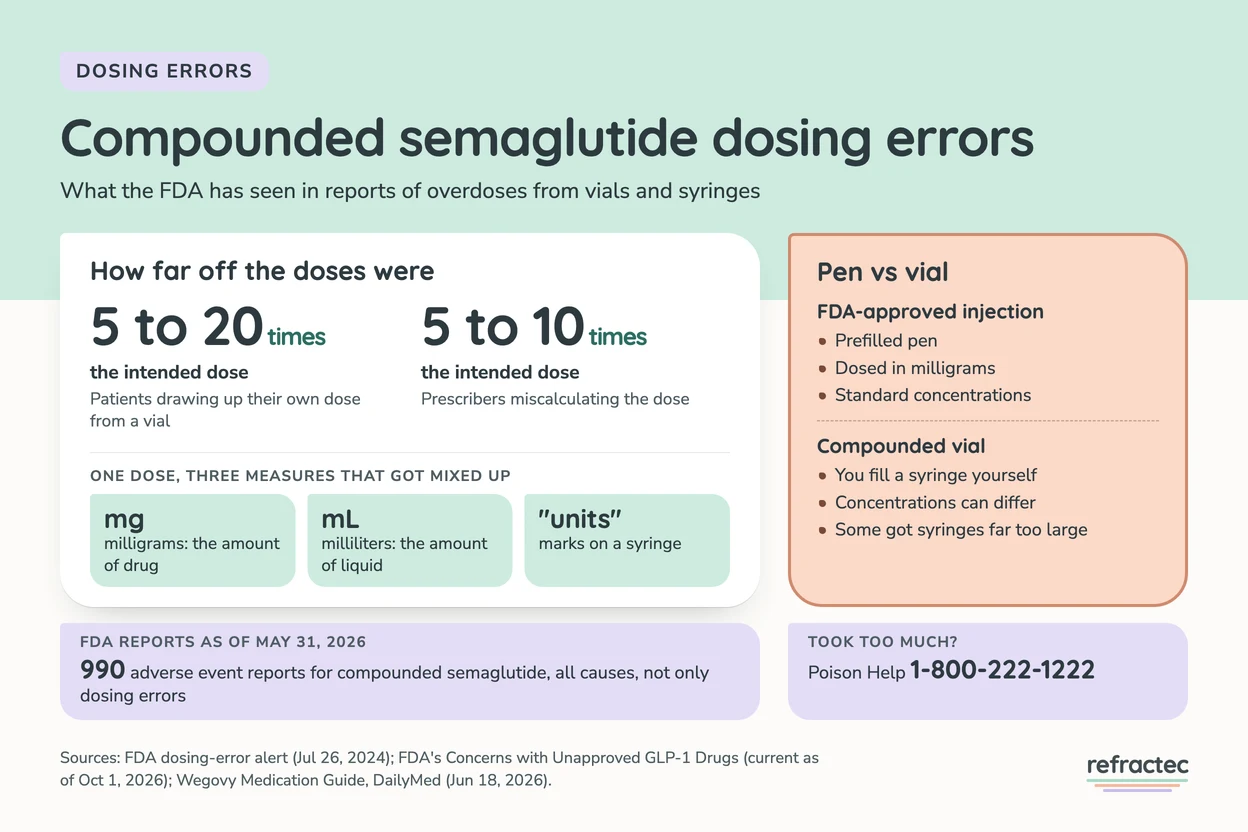
Compounded semaglutide dosing errors happen when the wrong amount of drug ends up in the syringe. The FDA has reports of people taking 5 to 20 times their intended dose, and some needed hospital care.1 The errors the FDA describes involved vials and syringes, not prefilled pens.
This guide explains what the FDA and poison centers have reported, and why the errors happen. It won’t tell you how to measure a dose. Your prescriber and pharmacist should show you that for your exact product.
What is compounded semaglutide?
A compounded drug is mixed by a pharmacy rather than made by a drug company under an FDA approval. The FDA does not review compounded drugs for safety, effectiveness or quality before they are marketed.
2
Pharmacies had more leeway to compound semaglutide during a national shortage. The FDA declared the semaglutide shortage resolved on Feb 21, 2025.3 That leeway ran until Apr 22, 2025, for state-licensed pharmacies, and until May 22, 2025, for larger outsourcing facilities.3
What dosing errors has the FDA seen?
In July 2024, the FDA warned about overdoses from dosing errors with compounded semaglutide injections.1 It said the errors came from two places. Some patients measured the wrong dose themselves, and some health care providers miscalculated it.1
Most reports described patients mistakenly drawing up more than the prescribed dose
from a vial that holds several doses.1 In those cases, people took five to 20 times more than the intended dose
.1
Prescriber math caused errors too. The FDA has reports of health care providers incorrectly calculating the intended dose
when converting between measures. Their patients took 5 to 10 times the intended dose.1 In one case, a patient couldn’t get clear instructions from a telemedicine provider and ended up taking five times the intended dose
.1
Why do errors happen with vials and “units”?
Approved semaglutide injections are simpler to dose. The FDA says they are dosed in milligrams, have standard concentrations and are currently only available in pre-filled pens.
1
Compounded vials work differently, and the FDA names several traps:1
- Three measures for one dose. Your dose can be written in milligrams (the amount of drug), milliliters (the amount of liquid) or “units” (the marks on a syringe). The FDA says confusion between these may have contributed to errors.
- Concentrations differ. The same number of “units” can hold a different amount of drug, depending on the vial. The FDA notes that
a single compounder may offer multiple concentrations
. - The wrong syringe. Some patients were given
syringes that are significantly larger than the prescribed volume
. - Little practice. The FDA points to people being unfamiliar with drawing medicine from a vial into a syringe.
A poison center in the US described three cases like this in 2023. Two people injected 10 times their dose, and one had measured in milliliters and units instead of milligrams.4 The authors note that vials do not use safety features provided by prefilled manufactured pens
.4
What symptoms did people report?
Stomach symptoms were the most common. The FDA lists nausea, vomiting and belly pain, along with fainting, headache, migraine and dehydration.1 More serious reports included acute pancreatitis and gallstones. Some patients sought medical attention or required hospitalization.
1
In the poison-center cases, all three people had nausea, vomiting and belly pain, with most symptoms lasting for days
.4 One went to a health care facility and got better with anti-nausea medicine and fluids through a vein.4
Semaglutide stays in your body a long time. The Wegovy label puts its half-life at about 1 week. That’s why it says observation and treatment after an overdose may need to go on for a while.5 It also lists severe low blood sugar among overdose effects seen with GLP-1 medicines.5
How many reports has the FDA received?
As of May 31, 2026, the FDA had received 990 reports of adverse events linked to compounded semaglutide.2 That figure covers every kind of side effect, not only dosing errors. The FDA pages we checked give no separate count of dosing-error reports.
The real number is probably higher. Under federal law, state-licensed pharmacies don’t have to send adverse events to the FDA unless they are outsourcing facilities. The FDA says that means it is likely that adverse events from compounded versions of these drugs are underreported.
2 The FDA also says it can’t always tell whether the drug itself caused a reported problem.2
The FDA has also received reports that may be linked to doses beyond what an approved label allows. Those reports described nausea, vomiting, diarrhea, belly pain and constipation.2
What do poison centers report?
Calls about GLP-1 medicines have climbed. A study of US poison-center data from 2017 to 2022 found 5,713 cases involving a GLP-1 medicine alone.6 About 4 in 5 (79.9%) were dosing errors made while taking the drug as treatment. The rate of cases rose 80.9% from 2021 to 2022.6
Most of those cases were mild. Still, 22.4% were seen at a health care facility, and 6.2% had a serious outcome, including one death.6 A later study counted 10,033 GLP-1 exposures from 2012 to 2023 and found most were mistakes with mild stomach symptoms.7
These studies cover all GLP-1 products. They don’t say how many cases involved compounded drugs rather than brand-name pens.6,7
How can you lower the risk?
The FDA asks prescribers and compounders to give patients the appropriate syringe size for the intended dose
and to explain how to measure it.1 It encourages patients to talk with their provider or compounder about how to measure and give their dose.1
- Know your dose in milligrams. Ask what it is, and what the concentration of your vial is.
- Have your pharmacist show you. Ask them to watch you fill the syringe once before you leave.
- Check again when anything changes. A new vial, pharmacy or syringe can change what your dose looks like.
- Don’t open a vial for too long. The FDA says to throw a multiple-dose vial away 28 days after first use, even if some is left. It also says to use a new, sterile needle and syringe for each dose.2
Never change your dose on your own. If the dose you were given doesn’t match what your prescriber told you, call them before your next injection.
What should you do if you took too much?
Call Poison Help at 1-800-222-1222, even if you feel fine. The Wegovy Medication Guide gives that number for anyone who takes too much semaglutide, along with your prescriber or the nearest emergency room.5 Have the vial with you when you call.
Go to urgent care or call 911 if you’re vomiting and can’t keep fluids down, or if you faint or feel confused.
Questions to ask your prescriber
Bring these to your next appointment. Tick them off as you go.
Endnotes
- The FDA's alert on dosing errors with compounded semaglutide. US Food and Drug Administration. FDA alerts health care providers, compounders and patients of dosing errors associated with compounded injectable semaglutide products. Content current as of Jul 26, 2024. Retrieved Oct 19, 2026.
- The FDA's concerns about unapproved and compounded GLP-1 drugs. US Food and Drug Administration. FDA's Concerns with Unapproved GLP-1 Drugs Used for Weight Loss. Content current as of Oct 1, 2026. Retrieved Oct 19, 2026.
- The end of the semaglutide shortage. US Food and Drug Administration. FDA clarifies policies for compounders as national GLP-1 supply begins to stabilize. Content current as of Apr 1, 2026. Retrieved Oct 19, 2026.
- Three dosing-error cases from one poison center. Lambson JE, Flegal SC, Johnson AR. Administration errors of compounded semaglutide reported to a poison control center: Case series. J Am Pharm Assoc. 2023;63(5):1643-1645. doi:10.1016/j.japh.2023.06.017. PubMed abstract retrieved Oct 19, 2026.
- What the Wegovy label says about overdose. Wegovy (semaglutide) injection and tablets, prescribing information (section 10) and Medication Guide, Novo Nordisk. DailyMed, label version effective Jun 18, 2026. Retrieved Oct 19, 2026.
- GLP-1 cases reported to US poison centers, 2017 to 2022. Gaw CE, Hays HL, Kemp CA, et al. Glucagon-Like Peptide-1 Receptor Agonist Cases Reported to United States Poison Centers, 2017-2022. J Med Toxicol. 2024;20(2):193-204. doi:10.1007/s13181-024-00999-x. PubMed abstract retrieved Oct 19, 2026.
- Poison-center trends after semaglutide's weight-loss approval. Miller J, Miller R, Varney SM, Han D. National Poison Center Trends in GLP-1 Receptor Agonist Exposures Following FDA Approval for Weight Loss. J Med Toxicol. 2026;22(2):275-285. doi:10.1007/s13181-026-01121-z. PubMed abstract retrieved Oct 19, 2026.
Reviewed against the sources above on Oct 20, 2026. Spotted something out of date? The desk dates every correction on the page.