Serious guides Retatrutide sold online (investigational, not approved)
Is research retatrutide safe? What tests and regulators have foundNot approved
Retatrutide is an investigational drug, not approved anywhere. Here is what tests, regulators and lawsuits have found about vials sold online as "research use only," and how they differ from the trial drug.
Is research retatrutide safe? No one can show that it is. Retatrutide is not approved: it’s an investigational drug made by Eli Lilly, and no regulator anywhere has approved it.1 Vials sold online as “research” retatrutide are not the drug tested in Lilly’s trials, and no one checks them for human use.
This guide covers what lab tests, regulators and lawsuits have found about these products. It doesn’t cover how to take retatrutide, because there is no approved dose. For what happened in the trials, see our guide to retatrutide side effects.
What does “research use only” mean on a vial?
Sellers often label retatrutide “research use only” or “not for human consumption.” That label means the product was never made or checked as a medicine you inject. Unapproved versions of GLP-1 drugs do not undergo FDA’s review for safety, effectiveness and quality before they are marketed
, the FDA says.2
The FDA also says these labels are often false. Here is how it puts it:2
FDA has warned companies that have illegally sold unapproved drugs containing semaglutide, tirzepatide, retatrutide, survodutide or mazdutide that are falsely labeled “for research purposes” or “not for human consumption.” These products have been sold directly to consumers for human use with dosing instructions.
The FDA urges people not to buy them. It calls them of unknown quality and may be harmful to their health.
2 Retatrutide also cannot be used in compounding under federal law
, so a pharmacy can’t legally make it for you either.2
What has the FDA told sellers?
The FDA sends warning letters to people who sell unapproved drugs. The earliest letter we found that names retatrutide is dated Dec 10, 2024. That seller’s labels said “RESEARCH USE ONLY.” Even so, the FDA wrote that evidence obtained from your websites establish that your products are intended to be drugs for human use.
3
Letters dated Mar 31, 2026, and Aug 24, 2026, made the same point to other online sellers listing retatrutide.4,5 In each one, a research-only label didn’t change the FDA’s view that the products were drugs meant for people.
Public Citizen, a consumer advocacy group, counted 14 FDA warning letters to companies selling retatrutide since 2024.11 It said most of those companies were still advertising unapproved peptides as of May 2026.
Has anyone tested retatrutide bought online?
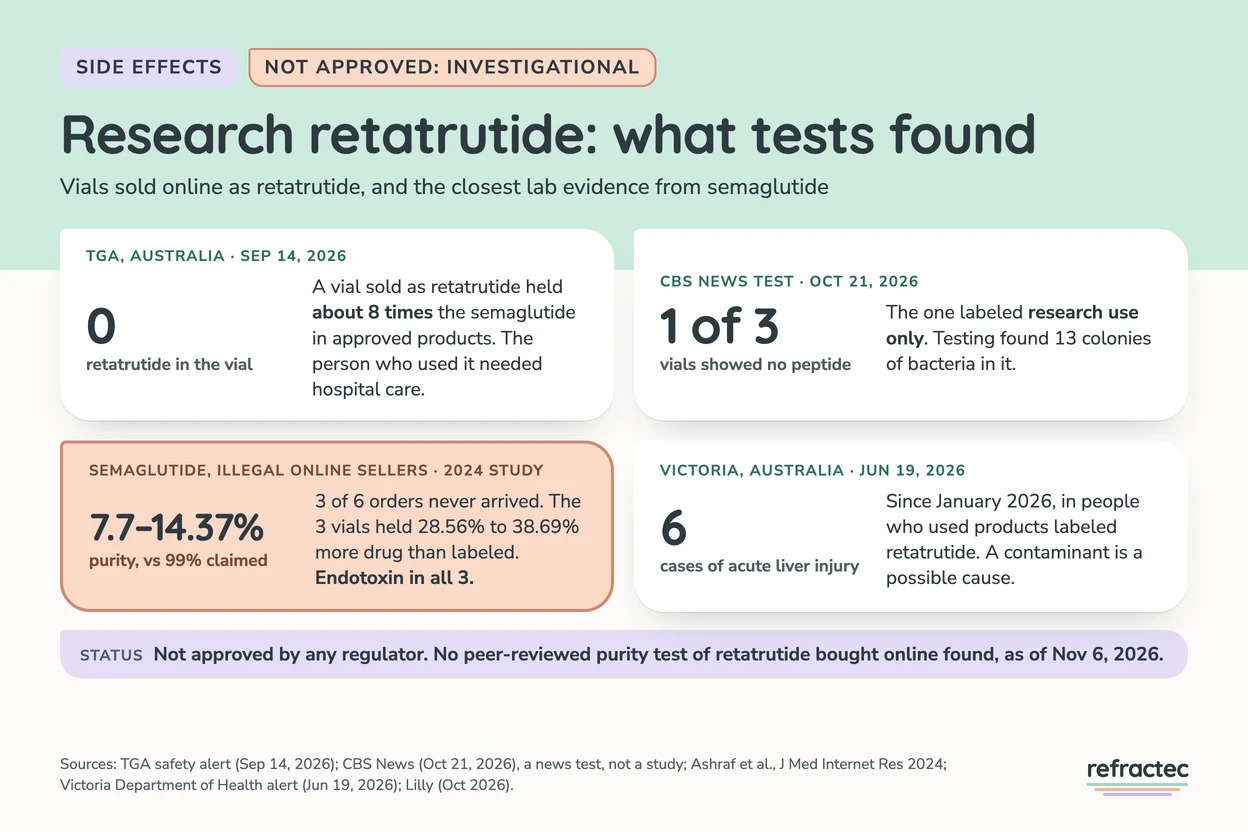
We found no peer-reviewed study that has tested retatrutide bought online, as of Nov 6, 2026. What we found is one regulator’s test and one news test. Each looked at very few vials, so neither tells you how common problems are.
Australia’s regulator. In September 2026, Australia’s drug regulator, the TGA, tested a vial sold as retatrutide.6 The person who used it had vomiting they couldn’t stop, tore their esophagus and needed hospital care. The lab found the product contained undeclared semaglutide and no retatrutide.
6
The amount of semaglutide was about 8 times the level in approved semaglutide products the TGA has assessed.6 Semaglutide is the drug in Ozempic and Wegovy. The TGA says any retatrutide accessed outside of clinical trials could be a counterfeit product.
6
A news investigation. In October 2026, CBS News bought three vials sold as retatrutide and had University of Iowa scientists test them.7 The two bought online matched a basic retatrutide standard one of the scientists made. That standard isn’t the same as Lilly’s trial drug, and the report gives no figures for strength or purity.
The third vial came from a convenience store in Brooklyn. Its label read “Research use only, not for human consumption.” The scientist said it does not look anything like a peptide
, and further testing found 13 colonies of bacteria in it.7
What did tests of other GLP-1 drugs sold online find?
The closest peer-reviewed evidence is about semaglutide, not retatrutide. In a 2024 study, researchers ordered semaglutide from 6 illegal online sellers.8 Three orders never arrived. The 3 vials that did were all judged substandard and falsified.
The vials held 28.56% to 38.69% more semaglutide than their labels said.8 Purity was only 7.7% to 14.37%, far from the 99% the labels claimed. Endotoxin, a substance from bacteria, was found in all 3 vials, though no living germs grew from them.8
This was a small study of a different drug. It can’t tell you what’s in any retatrutide vial. It does show how far an online product can drift from its label. Taking more GLP-1 drug than intended can make people sick, as the FDA found with compounded semaglutide dosing errors.
What harms have been reported?
In June 2026, health officials in Victoria, Australia, reported six cases of acute liver injury since January.9 All were in people who used products labeled “Retatrutide,” “Reta,” “R-10” or “R-20.” The officials said the effects were possibly associated with a contaminant
in the products.9
Symptoms included tiredness, yellow skin or eyes, belly pain, dark urine and bruising easily.9 Blood tests showed signs of liver damage, and possibly clotting problems.
In the US, Public Citizen counted 14 reported hospitalizations connected to retatrutide in FDA adverse event data, as of June 2026.11 A report like this doesn’t prove the product caused the problem. It also can’t show how often harm happens.
Why is Lilly suing sellers?
On Aug 12, 2026, Lilly announced six lawsuits against companies it says sell retatrutide illegally, according to news reports.10 Lilly said the companies falsely claim their drugs are for ‘research-use only’ when they are intended for human use.
10
Lilly also said it had reported more than 200 people and companies to regulators, law enforcement and licensing boards.10 These are Lilly’s claims in court, not findings by a judge. We found no ruling in these cases as of Nov 6, 2026.
How is a research vial different from the trial drug?
In Lilly’s trials, people get the drug from Lilly and are followed by a study team. In August 2026, Lilly said it was still finishing the manufacturing and quality data it needs to apply to the FDA.10 A research vial has none of that behind it.
A seller’s lab report can’t close that gap on its own. Lilly told CBS News: A single test is a snapshot, not a guarantee that the dose will be sterile or stable in two weeks
.7
The tests above show what can differ. A vial may hold another drug, much more drug than its label says, or bacteria. If you inject it, you won’t know which.
What side effects did the trial drug cause?
Even the real drug has side effects, mostly in the stomach. In TRIUMPH-1, an 80-week trial, about 42 in 100 people (42.4%) on the highest dose had nausea.12 That compared with about 15 in 100 (14.8%) on placebo.
Vomiting affected 25.3% on the highest dose, compared with 4.8% on placebo.12 About 11 in 100 (11.3%) stopped because of side effects, compared with about 5 in 100 (4.9%) on placebo. Skin that tingles or burns, called dysesthesia, affected 12.5%, compared with 0.9%.12
Our guide to retatrutide side effects covers each trial in more detail.
Is there a legal way to get retatrutide?
Not with a prescription yet. Lilly says no one can legally sell retatrutide for human use.1 It plans to apply for FDA approval in the first three months of 2027.13
For now, there are two legal routes. You can join a clinical trial, and ClinicalTrials.gov lists retatrutide studies.15 In August 2026, Lilly also began offering early access through doctors. It’s for a limited number of adults with severe obesity who meet strict criteria and can’t join a trial.14
If you’ve been searching for where to buy retatrutide, one outside guide sets out the legal routes and how to check a seller’s lab report. It covers clinical trials and Lilly’s expanded access program.
What should you do if you’ve already used it?
Tell your doctor what you took, when, and where it came from. Bring the vial or packaging if you still have it. Victoria’s officials ask doctors to collect exactly these details.9
They also advise anyone who keeps using these products to see a doctor about liver function tests.9 You can report a problem with any product to the FDA’s MedWatch program.2
Questions to ask your prescriber
Bring these to your next appointment. Tick them off as you go.
Endnotes
- Lilly's own answers about retatrutide. Eli Lilly and Company. What to know about retatrutide. Last updated October 2026. Retrieved Nov 6, 2026.
- The FDA's warning about unapproved and research-labeled GLP-1 drugs. US Food and Drug Administration. FDA's Concerns with Unapproved GLP-1 Drugs Used for Weight Loss. Content current as of Oct 1, 2026. Retrieved Nov 6, 2026.
- An FDA warning letter to an online seller of research-labeled peptides, Dec 2024. US Food and Drug Administration, Center for Drug Evaluation and Research. Warning letter, MARCS-CMS 695607, Dec 10, 2024. Retrieved Nov 6, 2026.
- An FDA warning letter to an online seller of research-labeled peptides, Mar 2026. US Food and Drug Administration, Center for Drug Evaluation and Research. Warning letter, MARCS-CMS 721806, Mar 31, 2026. Retrieved Nov 6, 2026.
- An FDA warning letter to an online seller of research-labeled peptides, Aug 2026. US Food and Drug Administration, Center for Drug Evaluation and Research. Warning letter, MARCS-CMS 735063, Aug 24, 2026. Retrieved Nov 6, 2026.
- Australia's test of a counterfeit retatrutide vial. Therapeutic Goods Administration (Australia). TGA tests counterfeit retatrutide product following serious adverse event report. Safety alert, published Sep 14, 2026. Retrieved Nov 6, 2026, from an Internet Archive copy because the TGA site timed out.
- A news investigation that tested three vials (news report, not a study). Geller L. We bought and tested what was sold as an experimental weight loss drug. The lab results were "pretty terrifying." CBS News, Oct 21, 2026. Retrieved Nov 6, 2026.
- Lab tests of semaglutide bought from illegal online sellers. Ashraf AR, Mackey TK, Vida RG, et al. Multifactor Quality and Safety Analysis of Semaglutide Products Sold by Online Sellers Without a Prescription: Market Surveillance, Content Analysis, and Product Purchase Evaluation Study. J Med Internet Res. 2024;26:e65440. doi:10.2196/65440. Full text retrieved Nov 6, 2026.
- Victoria's alert on liver injuries after products labeled retatrutide. Department of Health, Victoria (Australia). Toxicity linked to unapproved peptide product labelled Retatrutide. Health alert issued Jun 19, 2026, by the Chief Health Officer. Status: active. Retrieved Nov 6, 2026.
- Lilly's lawsuits against retatrutide sellers (news report). Healio. Eli Lilly files lawsuits against six companies for allegedly selling retatrutide. Aug 14, 2026. Reports Lilly's announcement of Aug 12, 2026; Lilly's own release could not be opened (access blocked). Retrieved Nov 6, 2026.
- A consumer group's count of hospitalizations and warning letters (advocacy report). Public Citizen. Hospitalizations, enforcement gaps, influencers tied to unapproved retatrutide products. News release, Jun 16, 2026. Retrieved Nov 6, 2026.
- Lilly's results announcement for TRIUMPH-1. Eli Lilly and Company. Lilly's triple agonist, retatrutide, delivered powerful weight loss in pivotal Phase 3 obesity trial. News release, May 21, 2026. Trial NCT05929066. Retrieved Nov 6, 2026.
- Lilly's plan to apply to the FDA. Eli Lilly and Company. Lilly's triple agonist, retatrutide, delivered substantial weight loss and A1C reduction, underscoring its potential promise for people with obesity and type 2 diabetes. News release, Sep 29, 2026. Retrieved Nov 6, 2026.
- Lilly's early-access program (news report). Sneha SK, Beasley D. Eli Lilly to offer early access to next-gen obesity drug to some patients. Reuters, via KSL.com, Aug 4, 2026. Retrieved Nov 6, 2026.
- Retatrutide studies listed on ClinicalTrials.gov. ClinicalTrials.gov. Search results for the intervention retatrutide. US National Library of Medicine. Retrieved Nov 6, 2026.
Reviewed against the sources above on Nov 6, 2026. Spotted something out of date? The desk dates every correction on the page.