Common guides Semaglutide (Ozempic, Wegovy, Rybelsus)
Semaglutide side effects: what's common, what's serious
Nausea and the other everyday effects, the rare warnings, and the signs that mean you should call, all taken from the FDA labels.
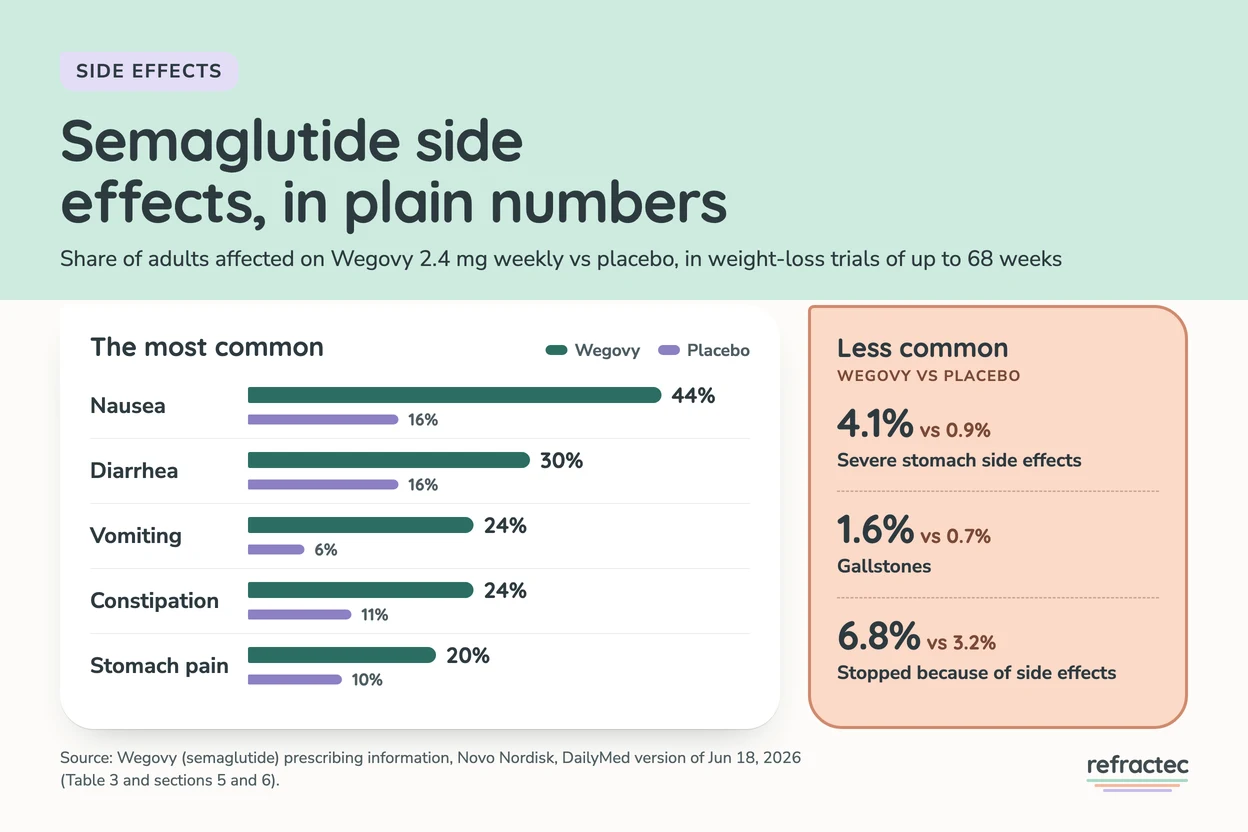
Most semaglutide side effects are about your stomach. Nausea, diarrhea, vomiting and constipation top the list on every semaglutide label, and they are most common while your dose is going up.1 A smaller group of serious risks, like pancreatitis and gallbladder problems, is rare but worth knowing by name.
This guide uses the FDA labels for Wegovy, Ozempic and Rybelsus. Each figure sits beside its placebo figure, so you can see how much comes from the medicine and how much is just everyday life.
Which medicines contain semaglutide?
Semaglutide is the active ingredient in three brands made by Novo Nordisk. Ozempic is a weekly injection for adults with type 2 diabetes.2 Rybelsus is a daily tablet for the same use, and its label now covers Ozempic tablets too.3
Wegovy comes as a weekly injection or a daily tablet. It’s approved for weight management and to lower the risk of heart attack and stroke in adults with heart disease and extra weight. The injection is also approved for a liver condition called MASH.1
Each label reports its own trials, with different people and doses. The labels say these rates can’t be compared directly from one drug’s trials to another’s, so the numbers below differ by brand.1
What are the most common side effects?
The largest set of numbers comes from Wegovy’s weight-loss trials. These included 2,116 adults on the 2.4 mg weekly dose and 1,261 on placebo, for up to 68 weeks.1
Nausea led the list. It affected about 44 in 100 people (44%) on Wegovy, compared with 16 in 100 on placebo.1 Diarrhea affected 30% compared with 16% on placebo, and vomiting 24% compared with 6%.1
| Side effect | Share of people, medicine then placebo |
|---|---|
| Nausea | Medicine 44%Placebo 16% |
| Diarrhea | Medicine 30%Placebo 16% |
| Vomiting | Medicine 24%Placebo 6% |
| Constipation | Medicine 24%Placebo 11% |
| Stomach pain | Medicine 20%Placebo 10% |
| Headache | Medicine 14%Placebo 10% |
| Tiredness | Medicine 11%Placebo 5% |
Share of adults with each side effect in three Wegovy 2.4 mg weight-loss trials of up to 68 weeks (2,116 on Wegovy, 1,261 on placebo). Stomach pain includes upper, lower and general belly pain or discomfort; tiredness includes weakness.1
Constipation (24% compared with 11%) and stomach pain (20% compared with 10%) were common too.1 Indigestion, bloating, burping, gas and heartburn also showed up more often than on placebo.1
The diabetes doses are lower, and so are the numbers. In Ozempic’s placebo-controlled trials, nausea affected 15.8% of people on 0.5 mg and 20.3% on 1 mg, compared with 6.1% on placebo.2 On Rybelsus 14 mg tablets, nausea affected 20% compared with 6% on placebo.3
Why does semaglutide upset your stomach?
Semaglutide slows down how fast food leaves your stomach.1 When food stays put longer, you may feel full sooner, queasy or bloated.
This slower emptying is also why the labels mention surgery. We cover that in the serious risks below.
How long do the stomach side effects last?
For many people, they ease over time. The Wegovy label says stomach side effects were reported most often while the dose was being raised.1 In the STEP 1 trial, researchers described nausea and diarrhea as typically transient and mild-to-moderate in severity
and said they subsided with time
.4
That’s why every semaglutide label starts low and steps up slowly. Wegovy injection starts at 0.25 mg once a week for 4 weeks, then goes up every 4 weeks.1 The usual maintenance dose is 2.4 mg weekly. The label also allows 1.7 mg, or up to 7.2 mg for some adults who handle 2.4 mg well.1
Ozempic also starts at 0.25 mg weekly for 4 weeks, then moves to 0.5 mg.2 If a step is hard to tolerate, the Wegovy label lets your prescriber wait 4 more weeks before the next one.1 Your prescriber may adjust your plan, so talk with them before you change anything.
How many people stop because of side effects?
Most people kept going. In the Wegovy weight-loss trials, 6.8% stopped for good because of side effects, compared with 3.2% on placebo.1 Stomach problems were the main reason: 4.3% stopped because of them, compared with 0.7% on placebo.1
Severe stomach side effects were less common. They affected 4.1% of people on Wegovy injection, compared with 0.9% on placebo.1
What other side effects are in the label?
- Headache and tiredness. Headache affected 14% compared with 10% on placebo, and tiredness 11% compared with 5%.1
- Dizziness. It affected 8% compared with 4%. Low blood pressure (1.3% compared with 0.4%) and fainting (0.8% compared with 0.2%) were uncommon, and some cases were linked to fluid loss.1
- Hair loss. It affected 3% compared with 1% on placebo. The label links it to weight loss, and it was more common in women than in men.1
- Skin that feels different. Tingling, burning or extra-sensitive skin affected 2% on 2.4 mg, compared with 1% on placebo.1
- A faster heartbeat. On average, resting heart rate rose by 1 to 4 beats per minute.1 Tell your prescriber if your heart races while you’re resting.
- Low blood sugar, if you have diabetes. In a trial of adults with type 2 diabetes, 6.2% had low blood sugar on Wegovy, compared with 2.5% on placebo.1 The risk is higher if you also take insulin or a sulfonylurea.1
Does a higher dose mean more side effects?
Often, yes. The Wegovy label compares the 7.2 mg and 2.4 mg doses in two 72-week trials.1 Nausea affected 39% on 7.2 mg and 35% on 2.4 mg, compared with 13% on placebo.1
The skin changes stood out most. They affected 22% of people on 7.2 mg, compared with 6% on 2.4 mg and 0.3% on placebo.1 Hair loss was 6% on 7.2 mg, compared with 3% on 2.4 mg and 1% on placebo.1
What are the serious risks?
These are rare, but each label lists them as warnings. Knowing the signs helps you act early.
- Pancreatitis. In Wegovy’s weight-loss trials, it was confirmed in 4 people on the medicine and 1 on placebo.1 The main sign is severe belly pain that won’t go away, sometimes reaching your back.
- Gallbladder problems. Gallstones affected 1.6% of people on Wegovy injection, compared with 0.7% on placebo. Gallbladder inflammation affected 0.6% compared with 0.2%.1
- Kidney problems from dehydration. Vomiting and diarrhea can dry you out. The labels report kidney injury after fluid loss, sometimes needing dialysis, and the Medication Guide asks you to drink fluids.1
- Serious allergic reactions. Swelling of your face, lips, tongue or throat, or trouble breathing, needs emergency care.1
- Eye changes with diabetes. In a 2-year trial of people with type 2 diabetes, eye complications from diabetic retinopathy affected 3% on semaglutide, compared with 1.8% on placebo.1 The gap was larger in people who already had retinopathy.
- Anesthesia and sedation. Because food stays in the stomach longer, there are rare reports of people breathing in stomach contents during procedures.1 Tell every care team you take semaglutide before any planned procedure; our guide to GLP-1 medicines before surgery covers what to ask.
- The thyroid warning. All three labels carry a boxed warning because semaglutide caused thyroid C-cell tumors in rodents. It’s not known whether this happens in people.1,2,3 Semaglutide isn’t for anyone with a personal or family history of medullary thyroid cancer or a condition called MEN 2.1
What about NAION, the eye condition in the news?
NAION is an eye condition that affects the optic nerve (our semaglutide and NAION guide has the full story) and can cause loss of vision.5 The concern began as a signal from observational studies. In adults with type 2 diabetes, several large studies linked semaglutide with about twice the risk of NAION.5
That works out to about one extra case for every 10,000 people treated for a year.5 Studies like these show a link, not proof of cause. Even so, Europe’s drug regulator, the EMA, concluded in June 2025 that NAION is a very rare side effect. That means it affects up to 1 in 10,000 people.5
The EMA says semaglutide should be stopped if NAION occurs.5 The US labels we checked, from 2026, do not list NAION.1,2,3 If you notice sudden vision loss in one eye, get care the same day.
Has the label changed recently?
Yes. The Wegovy label updated its warning on severe stomach side effects in October 2025.1 In February 2026, it removed a warning section on suicidal behavior and ideation.1
Labels change as new data come in. Your pharmacist can print the current version for you.
Questions to ask your prescriber
Bring these to your next appointment. Tick them off as you go.
Endnotes
- What the Wegovy label says about side effects. Wegovy (semaglutide) injection and tablets, prescribing information and Medication Guide, Novo Nordisk. DailyMed, label version effective Jun 18, 2026. Retrieved Oct 2026.
- What the Ozempic label says about side effects. Ozempic (semaglutide) injection, prescribing information, Novo Nordisk. DailyMed, label version effective Jun 1, 2026. Retrieved Oct 2026.
- What the Rybelsus label says about side effects. Rybelsus and Ozempic (semaglutide) tablets, prescribing information, Novo Nordisk. DailyMed, label version effective Jan 30, 2026. Retrieved Oct 2026.
- The STEP 1 weight-loss trial. Wilding JPH, Batterham RL, Calanna S, et al. Once-Weekly Semaglutide in Adults with Overweight or Obesity. N Engl J Med. 2021;384(11):989-1002. doi:10.1056/NEJMoa2032183.
- Europe's review of semaglutide and the eye condition NAION. European Medicines Agency. PRAC concludes eye condition NAION is a very rare side effect of semaglutide medicines Ozempic, Rybelsus and Wegovy. News release, Jun 6, 2025, revised Jun 13, 2025.
Reviewed against the sources above on Oct 19, 2026. Spotted something out of date? The desk dates every correction on the page.